

One and a half years after my post about why Starbucks China was falling behind its competitors, I stand firm in what I said: that Starbucks continues to…
Fail to meet Chinese consumers’ changing perception about product price.
Fail to create new experiences and capture the cultural zeitgeist.
Fail to innovate on the product level at China’s speed.
After all these months, the problems have gone from bad to worse — China comparable store sales declined by 14% in the most recent quarter, with revenue at $783.7M, barely up from $763.8M in Q2 2023, despite an increase of >1,300 more stores on paper — while Chinese consumers become aggressively discount-driven.
However, the recent changes in new leadership have made me optimistic about Starbucks in China. So in this post, I want to discuss why I feel that way, what they must do, and what could follow.
My story with Starbucks:
As an avid coffee drinker and researcher, I first learned about Starbucks around 2008 while I was in school, about a decade after it entered China. I went to the busiest commercial street in Suzhou (then considered a second-tier city), and had my first taste of a Frappuccino. It wasn’t mind-blowing but I low-key wanted to share this moment with friends, so I posted a picture of me and the drink on my Renren, a social networking site similar to Facebook. It was worth the price.
However, what used to be seen as an aspiring brand is now a subpar backup plan to me: it only stands out in travel channels where it lacks other competition. Being health conscious, I’d hate to unknowingly consume a large amount of sugar (so I stay away from the new sugary drinks). I started doing my own pour-over and know that I like light and medium roasted beans from Ethiopia the best. Moreover, whenever I choose to work at Starbucks, it’s rare where I’m not bothered by non-paying customers who sit near me and play on phones without headphones.
The coffee is meh, the space is meh.
Of course, you can say that I have changed over the 15 years or so, but so have Chinese consumers. Industry insiders concluded that customers prefer a lighter roast (VS Starbucks’ typical dark roast), as speciality coffee movement continues to flourish in China. 74% of participants in a 2022 survey wanted to have more low-sugar or no-sugar food and drink. The no-sugar tea brand Oriental Leaf 东方树叶, which was voted as one of the worst drinks in 2016, became a national favorite in recent years.
Starbucks has made great contributions in China over the last two decades. It’s a brand that taught China what coffee is, and subsequently, has led the industry’s development, nurtured talents for the brands that came after it. What’s essentially changed is China as a whole has become more sophisticated in taste, but Starbucks stayed where it was.
The mismatched conception about Starbucks from the HQ:
It’s seen as premium. While that may be the case in the US, it’s NOT the case in China anymore.
This matters greatly because it affects how every decision is made:
Pricing: While China’s expectation has lowered to mid-to-high teens thanks to Luckin, Manner and Cotti, Starbucks’ price (30-40 RMB) feel increasingly non-justified.
For example, you can get an Americano at Starbucks Reserve Roastery for 49 RMB, OR for the same price, you can get a seasonal coffee drink at the nature-inspired coffee Saanci 山池, featuring a single-origin Ethiopian bean and wild apricot jam infused with osmanthus and oolong tea leaves. Judging from a recent interview that newly installed CEO Brian Niccol had with CNBC’s Andrew Ross Sorkin, the perception of Starbucks’ high pricing is a global problem, but China’s discounting environment only intensifies the issue.
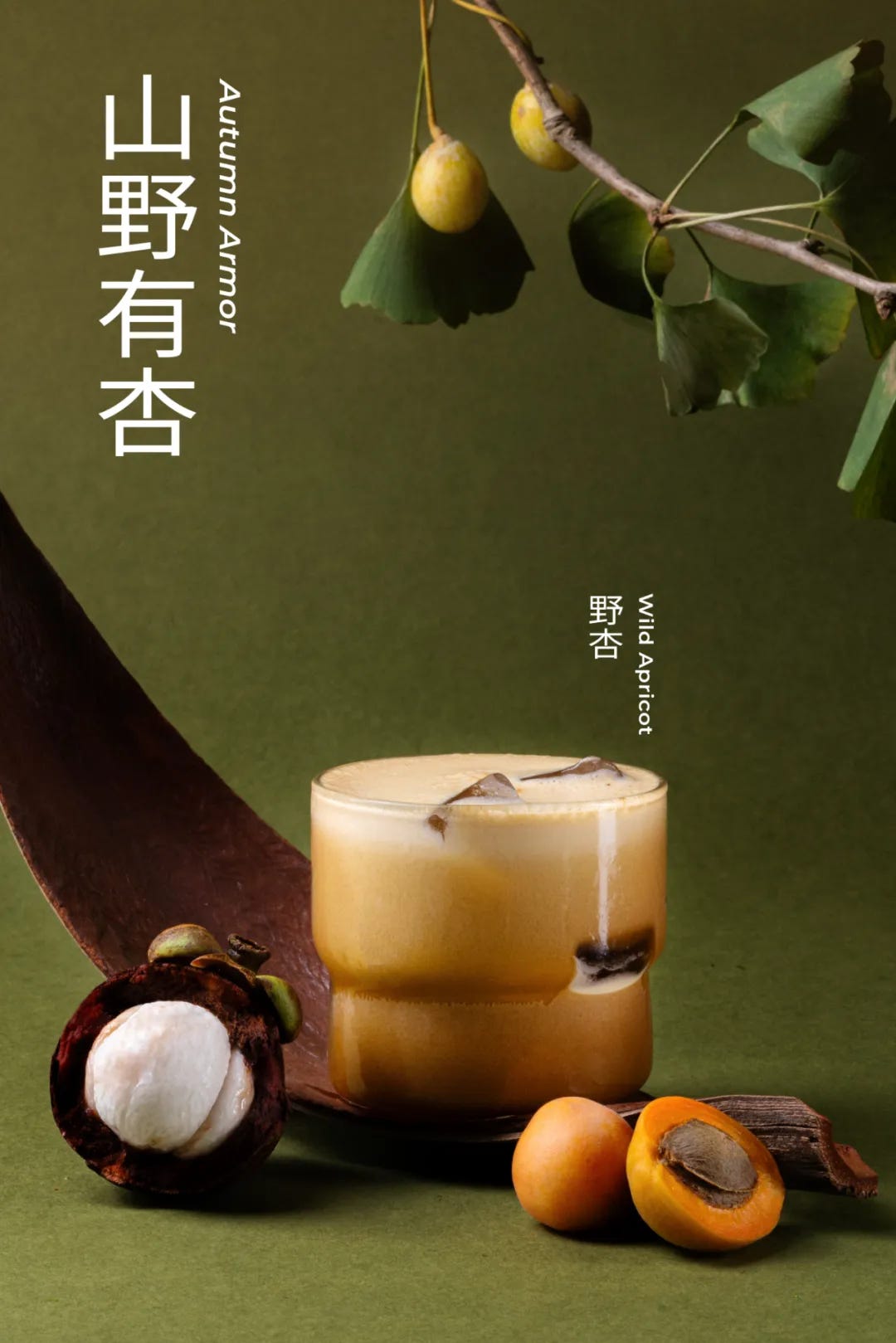
Product R&D: Take this year’s Chinese New Year products as an example, it came up with limited drinks (incl. pork latte) at the price tag of 68 RMB. It wasn’t considered innovative, some say one can make their own pork latte with a regular latte and pork jerkie. In the meantime, so many regional flavors are flourishing in China as local cafe owners take pride in the culture and local ingredients: Gooseberry and Wampee from the South, Jasmine flower from the East, some of them end up being adopted by larger Chinese chains.
Marketing: For Oleato’s launch party in March in Shanghai, Starbucks did a lush VIP dinners. If your audience is millions of office workers in China, why do something that only dozens people participate, while your real audience can only catch a glimpse from social media?
This highlights a misunderstanding of premium. The real definition of premium for coffee is that consumers are buying it because it’s worth the price, and it’s a treat to themselves. It doesn’t mean you have to throw dinner events like high fashion brands.


Competition: I assume when many think of Starbucks’ competition in China, they only think of Luckin but it’s way beyond that. There are local cafes like Saanci with seasonal menus, there are milktea shops like health-conscious Chagee, there are cheaper options like Cotti, Mixue’s subsidiary Lucky Cup, coffee shops of convenient stores, and KFCs and McDonalds’ coffee chains.
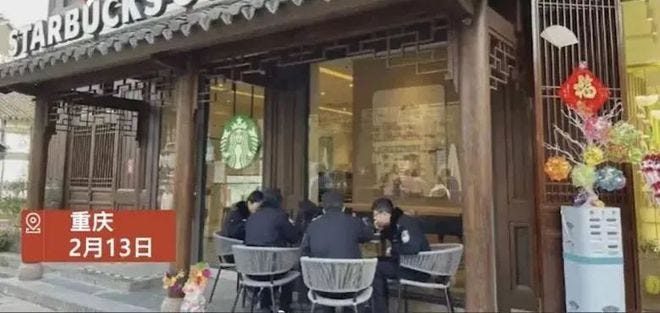
The space: Non-paying customers frequently take up seating and make noises at almost every Starbucks you go to in China. Since the backlash in early 2022, when Starbucks was widely criticized and called “arrogant” by state media People.com for asking police officers eating lunch on the premises to leave, Starbucks has been treading carefully on this issue. Admittedly, it’s a thorny issue, but the majority of the group aren’t the police, and Starbucks should look for ways to uplift the in-store experience for those who pay, as simple as that.
What am I optimistic about: new leadership, small but decisive changes, and its stance against Luckin in the US
I'm optimistic about the leadership change at Starbucks. I suspect that, along with growing dissatisfaction with the former CEO, there was also doubt about the ex-China CEO Belinda Wong’s recent performance, as much media coverage had discussed how she had "turned China around" Starbucks a decade ago.
The new China CEO Molly Liu, who was the brain behind “Starbucks Delivers” and “Starbucks Now”, seems more in tune with China’s ever-changing digital space.
I’m also glad to see the Oleato line discontinued in the US — Starbucks should consider doing the same in China. It was a misstep from the start as the concept did not came from the dedicated R&D team, store managers or customers; it came from the former CEO’s trip to Italy.
China has a saying for that kind of top-down decision-making: 拍脑袋/拍脑门 (slap your head and come up with an idea). Without thorough verification by a dedicated team, these snap decisions can backfire. State media Xinhua, out of all places, wrote in a feature that this is “a fundamental cause of administrative inefficiency,” and that “such a decision-making approach has far-reaching harmful consequences.”
Oleato’s price and product are out of touch especially for China. The oil separates easily from the rest of the drink, which doesn’t work well for China’s delivery-driven market. Additionally, both U.S. and Chinese consumers reported a laxative effect.
I’m also optimistic about Starbucks in the home market. Despite many media pointed at the fact that its enemy Luckin is targeting US, it takes time for Luckin to find its footing with the right message and audience while still being haunted by the accounting fraud in the US.
Luckin resonates with laborers/wage earners (打工人), while it makes sense for it to enter Southeast Asia, given the new waves of Chinese expats in the area, but there’s a consumer culture hurdle between modern China and the Chinese diaspora in the West. In the US and the UK, VC-backed Blank Street Coffee is more of a problem than Luckin.
Here are some more suggestions moving forward, let me know if I should elaborate on any below:
Highlight regional differences when it comes to product R&D and store design
Safeguard third spaces from non-paying customers
Make more/most cafes pet friendly, which aligns with the retail norm in China
Encourage intrapreneurship
When and if Niccol comes to China, he should visit 3rd, 4th-tier cities in China for a broader perspective
Starbucks represents a bunch of multi-national consumer brands currently in China market, which reflect an embarrassing status of ‘one cannot reach the high or accept the low’ (高不成低不就 in Chinese idiom)
I would argue that Starbucks has mistaken premium pricing for premium experience. In the UK (and Hong Kong) Starbucks charges a premium price for mediocre products - this has been especially true post-COVID. So the discounting strategy for 'loyal' users has been more about reasonable pricing in relation to the product.
While I prefer a brew coffee, Starbucks is still struggling to make a good flat white trying to catch up with the trailing edge of expresso culture.
The experience has declined further with the long queues due to speciality drinks and lack of pottery mugs if you are drinking in (though this seems to be changing). You get the kind of fringe people, usually seen at Walmart or McDonalds in there like the more belligerent homeless people panhandling and causing a commotion in US and UK branches. Even the wi-fi doesn't work half the time in my local Starbucks store.