

Last weekend, I shared about my trip to Mixue, today I want to show you what I saw and was thinking when visiting Shangqiu, the founders’ hometown and one of the birthplaces of Chinese civilization.
I had to admit that my Shangqiu trip wasn’t thoroughly planned, I only visited the main tourism sites and stayed at the supposedly best local hotel (Xinhua Nation-Building Hotel, same as the nickname Chinese people gave to Trump). Another caveat is that and the founders were not from the city center, but from the counties under the administration of Shangqiu. Still, I believe one universal truth is that people embody the traits and characteristics of their hometown, be it accurately or broadly defined.
The main tourist attractions — Shangqiu Old Town, “Fire God Deck 火神台” (China’s earliest astronomical observatory) — as well as local event and propaganda posters helped me connect the dots culturally. They also gave me more context as to what this city is facing, why Henan locals appear to be more patriotic, and why the late Premier Li Keqiang seemingly had more perspective on people’s livelihood.
Let me know your thoughts below!
Lost opportunity in local economy
Compared to Shandong Zibo BBQ, ice festival in Harbin and most recently, New Year celebrations in Fuzhou, Shangqiu hasn’t found a pinpoint to connect with today’s short-video-driven, digital-native audience.
As third-tier cities go, locals have a lot to take pride in in terms of history (which is not true in all places of China, especially not in my hometown that was originally named as Sandbank County).
Shangqiu had been an important place for many dynasties in China, the current old town astonishingly sat on their precedents from different dynasties that span across the last four thousand years, which had been engulfed by natural causes. I’m amazed reading this piece of background info, again, probably because I’m from somewhere built on sand.
For historic reasons, in 2008, Shangqiu was originally chosen as a key stop on the torch itinerary for Beijing Olympics. Two anti-CPC media reported that the stop was taken out because the local torch bearer was involved in illegal fund raising.
The old city itself has a scattering of tourists when I went on a workday, with shop owners idly scrolling on their phones and the elderly taking casual strolls.
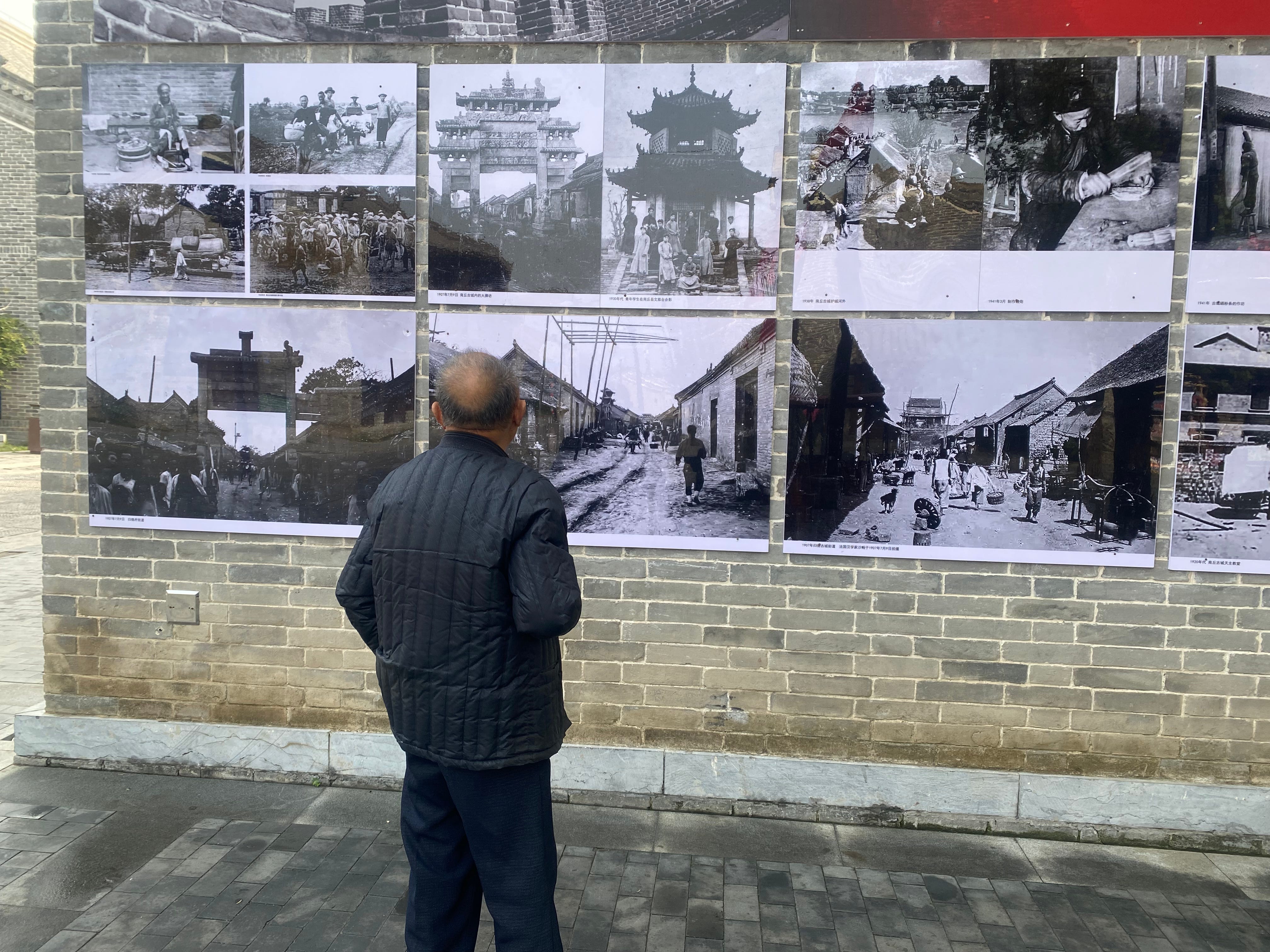
China has too many cookie-cutter old towns — 2,800 in total as early as 2012, according to an estimate by the Institute for Ancient Cities and Cultural Studies in China, and many of them are fake. As a result, the real ones like Shangqiu’s pale into insignificance. It was a lost opportunity on Shangqiu’s part and on China’s part.
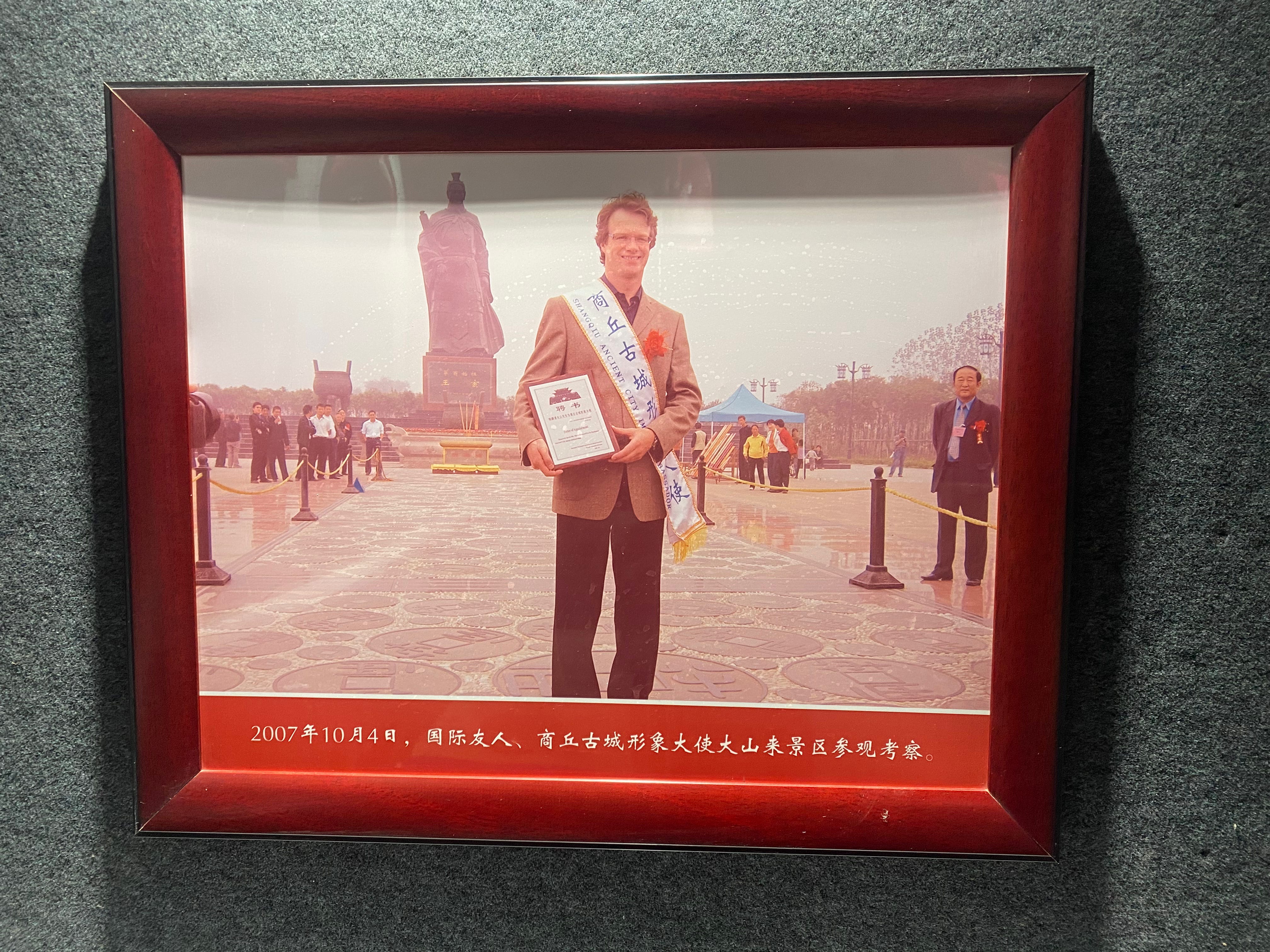
In 1920s, the grandparents of Canadian comedian Mark Henry Rowswell, or better known as ‘China’s favorite foreigner Dashan, came to work in Shangqiu (then called Gui De Ancient City 归德古城) as doctors. They later had to leave during war time. The family did not know about Shangqiu until Dashan told story to Chinese media and a Henan journalist connected the dots. Dashan was hired by the city as its tourism ambassador in 2007. It was a feel-good story that you rarely hear these days.
Strong patriotism
I always say that patriotism and nationalism is a spectrum. In both Zhengzhou and Shangqiu, I’m seeing quite a strong vibe merging the two. And it makes sense there, China’s 5,000-year history is quite unevenly distributed and Shangqiu was one of the oldest cities that lifts up the image.
Below, the two posters show the annual Emperor Huang Ancestral Worship Ceremony held in Zhengzhou (“Same roots, Same ancestors, Same source”) and International Chinese Merchants Festival in Shangqiu (“All Chinese merchants are of one mind, go ahead hand in hand”).


The level of Chineseness is unparalleled elsewhere, and brands mirror the sentiment locally.
In the mall opposite of the Zhengzhou Mixue store I went to, I was surprised to see an unfamiliar facade of Miniso. The Chinese retailer that leveraged of the Japanese sounding name and branding in its initial days, changed its universal store sign (left) to “China Mingchuang” written in calligraphy on a traditional plaque. So much so that I didn’t even realize it’s Miniso until I see the products and posters in side.
It feels right to assume that this was a local adaptation by a franchisee, as only 29 out of 4,221 stores, or 0.69% of Miniso stores in mainland China by Q3 2024 are directly owned.


Last words: In 2020, the late Premier Li Keqiang famously said during the period of National People's Congress:"There are 600 million people in China whose monthly income is only around 1,000 RMB."
Li wasn’t known for being outspoken, but one of the few times his words or initiatives made headlines in recent years was when they related to Chinese’s masses (i.e. another one is the “street vendor economy”, which Xi said no to). Beware that highlighting ‘bitterness’ of people’s everyday lives is considered taboo.
After learning that he had worked here from 1998 to 2004, and after visiting Zhengzhou, Shangqiu and Xinxiang, I realized where he got his perspectives from.

Around the time when Xi spent his formative political years in Zhejiang — one of China’s wealthiest provinces — Li worked in Henan, holding positions as Deputy Secretary of the Henan Provincial Party Committee, Acting Governor, Governor, Provincial Party Secretary, etc. In Henan, street vendors have been a vibrant and common scene, as well as the most accessible means for job opportunities, whereas in other more developed regions, they may be viewed as a burden of their ‘civilized city (文明城市)’ election.
If there’s one key takeaway, it’s this: If you work on any China-related projects, you should come see it and experience life from the perspective of the people you are serving and selling to. (I’m saying to myself too: Drinking at bars in Shanghai doesn’t count.) 🔚
Wow the Miniso localization is kind of cool!