

Welcome to “China color” — a column that records Chinese people’s unfiltered, original voices and my field trips.
Last week, I picked some favorite Chinese New Year campaigns while dissing others. As the public holiday concludes, let’s take a look at what individuals are happy, concerned and hopeful about.
On a bigger picture, it’s the very first year that we are celebrating a special edition of the Spring Festival. The government deemed the year of the Snake “intangible cultural heritage” (非遗) edition, after the holiday was added to UNESCO’s Intangible Cultural Heritage of Humanity list in early December. Beyond international luxury brands embracing the theme, you might also have come across domestic makers of snacks, handicrafts and accessories dubbing their products with it. I believe that this term is swiftly replacing the usage of guochao/China chic and new Chinese style in marketing in the coming year.


On a personal level, the most distinctive change I’m witnessing involves the expectations on females’ responsibilities during the annual holiday.
Women are the unsung heroes of Spring Festival who are traditionally in charge of food prep, cooking, cleaning, hosting guests but barely take any credit. While traditions vary in China, such as the men in Sichuan province and Yangtze River Delta are known to shoulder these duties, women are historically expected to do more. The first two posts showed how an awakened younger generation is changing these norms.
Meanwhile, some tech workers are frustrated about their social statuses back home, as they feel they receive less respect compared to relatives who are part of the local government. Some are deeply bothered by relatives seeking to borrow money as they are portrayed as high earners by the proud in-laws.
Lastly, I found it interesting to learn which temples Chinese investors prefer to visit at the beginning of the CNY. Capitalism and religion do not overlap typically, especially in this officially atheist country. However, this practice reflects deeply embedded cultural customs that perhaps equate to the ‘goodwill’ investors hope to add to their portfolios.
Women behind CNY 💥
“When New Year’s Eve dinner becomes the burden of female” Xiaohongshu user @Shu Qiaoqiao (IP: Fujian province)
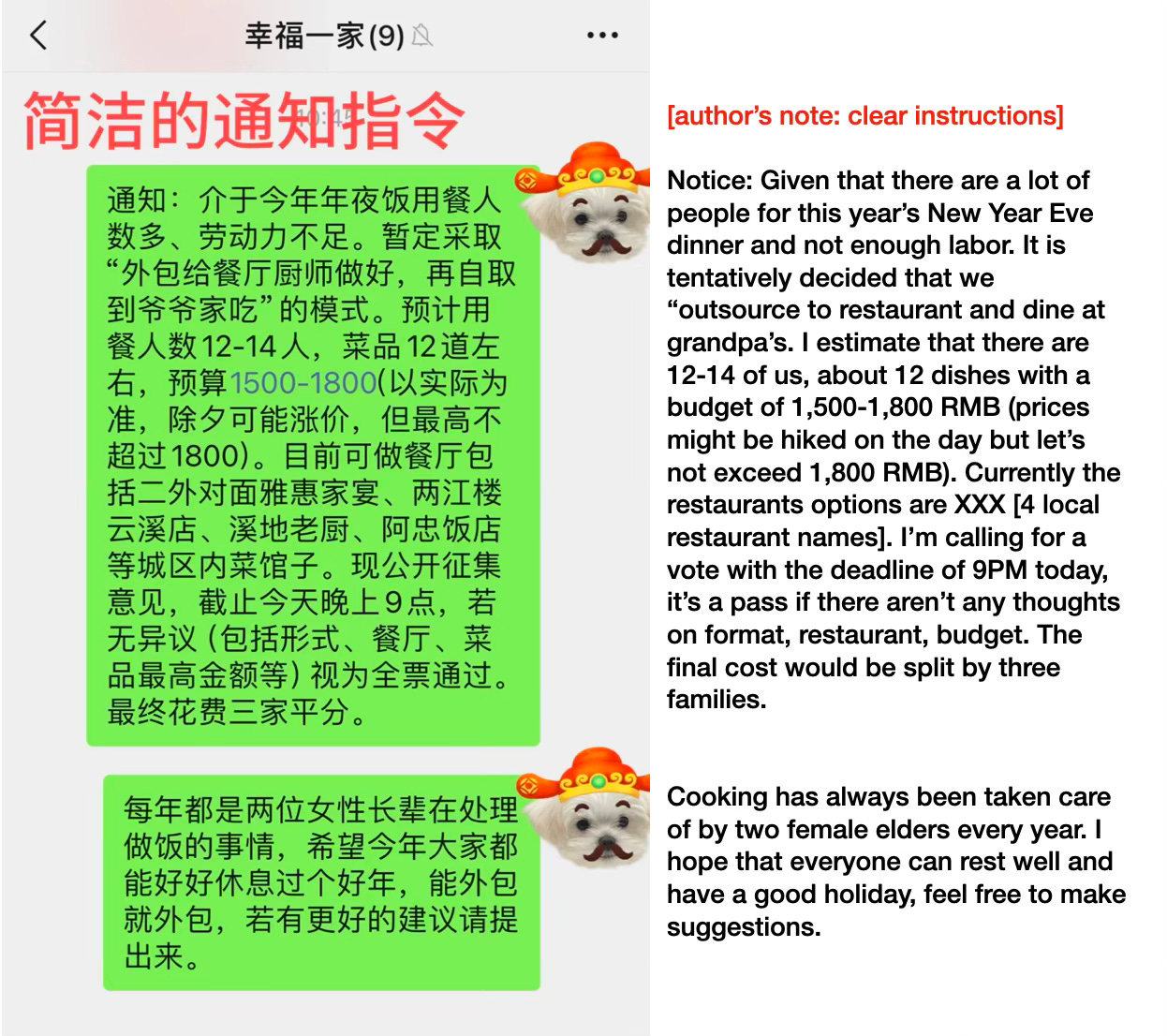
“It’s always been my mom and aunt cooking for the whole family of over 10 people. They start working in the kitchen at 9AM, also handling the ancestral rites for my late grandmother, and continue until nearly noon. This is quite unreasonable. I can only offer minimal assistance, and my male cousins are of no help, as men in Minnan culture (coastal region in South Fujian Province) typically do not enter the kitchen. The male elders in the family, including my own father, are also unreliable in this regard.
This year, I was thoroughly frustrated and decided to apply the communication method from my workplace to our family WeChat group. Although it may seem impersonal and direct, it ensures effectiveness and efficiency.
There are still invisible tasks for me as the coordinator, such as contacting restaurants, ordering dishes based on the number of people, comparing prices, ensuring there were soft foods suitable for my grandfather, and arranging for meal pickup. If this plan proves feasible this year, we will continue to implement it in the future.
For the sake of my mother, aunt, and future daughters-in-law, to reduce their burdens, I am taking this first step.
If I cannot overthrow the old order, then I will establish a new one!”
“Spring festival is an exhausting workday for most rural women” WeChat blogger @your dog uncle
“The Spring Festival is an overwhelming period of labor for most rural women, with preparations beginning as early as the twelfth lunar month (usually in December). The first task involves preparing cured meats: selecting and purchasing the meat, comparing prices, seasoning, stuffing, daily sun-drying, storage, and distribution.
The second task is stockpiling supplies. Deciding what and how much to buy, where to purchase, how to match ingredients, and how to choose quality items require numerous time-consuming decisions. Preparing a sumptuous homemade New Year's Eve dinner is a complex task that demands meticulous planning.
In our local tradition, the New Year's meal is consumed at noon, setting a strict deadline for the main cook to serve dishes before 12PM. Completing 16 to 20 elaborate dishes within four hours necessitates days of advance preparation, including making meatballs, pre-mixing ingredients, and marinating meats, to make sure that everyone can enjoy the meal on time.
After the New Year's meal, preparations continue for hosting guests from the first to the sixth day of the lunar new year (this year it’s Jan 29 to Feb 4). My mother and mother-in-law often work late into the night.
In our region, each guest meal comprises at least 12 dishes, with different menus for lunch and dinner. Guests may use over 20 plates each meal, and the tasks of washing dishes and cleaning up can take one to two hours.
Despite preparing lavish meals, these women often only have time to eat leftovers after finishing their work.
…I continually express to my parents the necessity of equality and respect within the family, sharing household chores equally until changes happen.”
Big tech workers 💥
“Returing home for Spring Festival, my social status cannot compare with those who work within the system” from a Maimai user, republished by PMTOO on WeChat.
“Returing home for Spring Festival, my social status cannot compare with those who work within the system.
On the first day of the Lunar New Year, our entire family gathered at my eldest uncle's house to pay New Year's visits. My brother holds a section-level position in a municipal unit (our hometown is a small county). When relatives saw him, they were very courteous and eagerly engaged him in conversation. Meanwhile, I was left on the sidelines, with only a few people occasionally coming over to greet me.”
“Returning to my hometown for the Spring Festival, people surrounded my husband, who works at Alibaba, to borrow money” republished by WeChat account @Ant speaker
“Returning to my hometown for the Spring Festival, during this morning's New Year greetings, my mother-in-law proudly told relatives and friends that her son earns a million RMB annually and works for a prestigious company that even sponsored the Spring Festival Gala. Her face was full of pride.
At noon, after the entire family finished lunch, my husband's eldest uncle subtly hinted at borrowing 50,000 RMB to tide over his business after the holiday. Then, my husband's younger uncle half-jokingly mentioned that his son is buying a house after the New Year and might need to borrow some money from my husband.
I was speechless. Firstly, we don't have an annual salary of a million RMB; my husband is just a P7. Secondly, we have a mortgage to pay in Hangzhou and a child to raise.
Finally, I told my husband that if they come asking for money, we should just direct them to his mother.”
The original post seems to be from Xiaohongshu/Rednote but I’m not able to find it.
Investors, Start-up founders 💥
Investors’ “first-incense* hierarchy” in the year of the Snake, as told to China Venture
*Burning incense is an ancient Chinese folk custom. The first incense in the lunar new year is said to have the best merits and would return the best blessings.
‘Investor J told [China Venture] that top investors from leading institutions prefer visiting Tanzhe Temple (潭柘寺).
“Many started going to Tanzhe Temple when they were investment managers and have continued annually for over a decade; now, most of them have become partners in their firms,” J said.
It's important to note that their consistent choice of this temple isn't necessarily about its perceived efficacy but more because Tanzhe Temple, as Beijing's oldest temple, holds an irreplaceable place in investors' hearts. There's a local saying: "Tanzhe Temple came first, then Beijing city."
In Hangzhou, most people still prefer Lingyin Temple (灵隐寺), which known for its influence and status. One detail is that an investor friend mentioned seeing the latest Lingyin Temple merchandise — calendars or door stickers inscribed with "Joyful Promotion" by Abbot Guangquan — in more than one big boss's office.’
DeepSeek Founder Liang Wenfeng’s trip back home: Financial Times (images from multiple Chines media and self-media accounts)
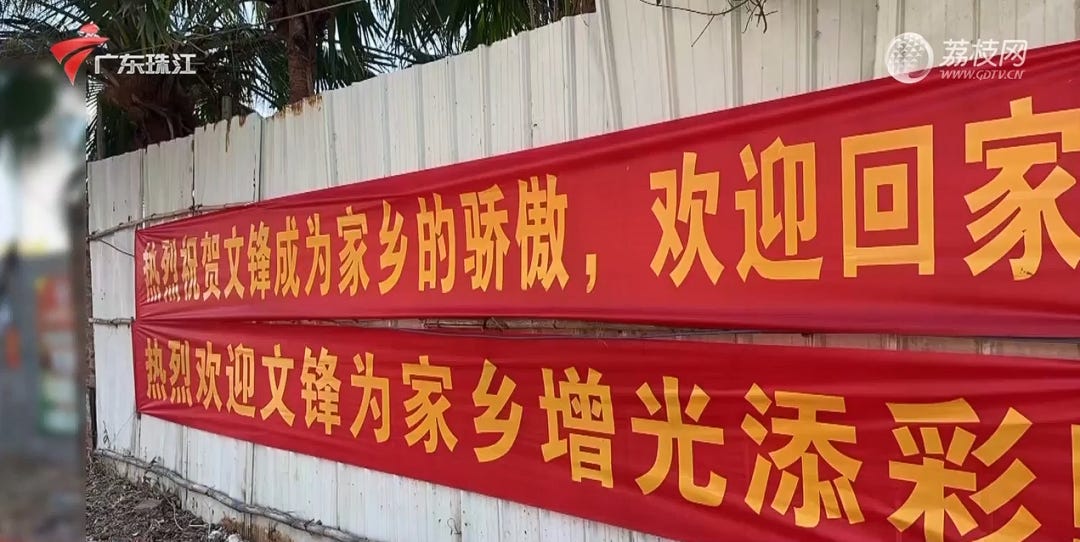
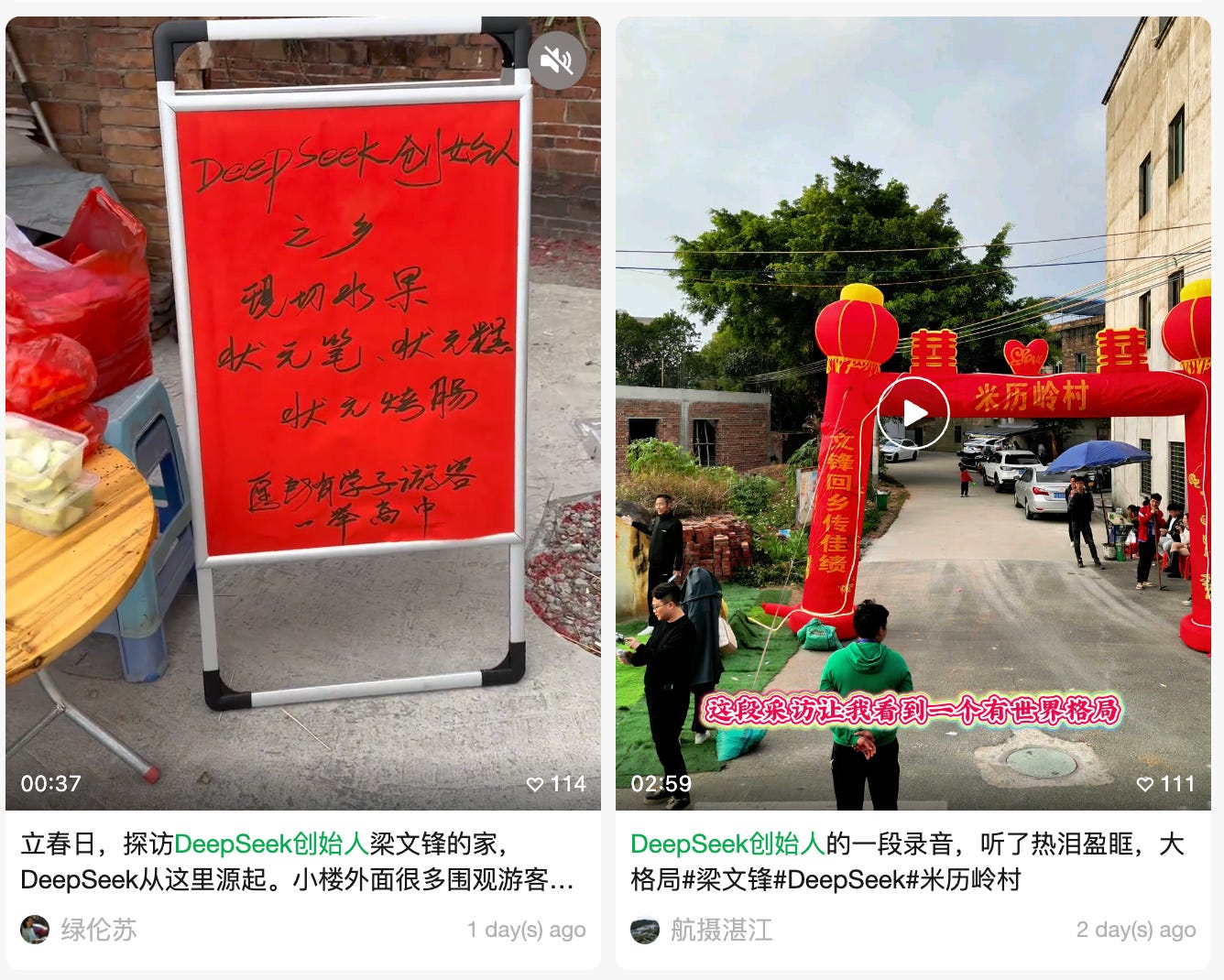
‘…Mililing villagers, a small community in the southern province of Guangdong where Liang grew up and where the 40-year-old billionaire returned home for the Lunar New Year holiday, flanked by security guards. Mililing is so small that there appears to have hitherto been nothing written about it online in English.
The reception was jubilant. “Liang Wenfeng returns to his hometown to spread good results and add energy to rural revitalisation,” wrote one banner adorning an inflatable red arch. Liang’s family home has become an unlikely pilgrimage site for those interested in seeing where this reluctant celebrity was raised.’
Editor’s note: Liang’s home 广东湛江吴川市覃巴镇米历岭村 is in a village under the administration of a county-level city. As the press and visitors swarmed into the village (as they have done with Olympic diver Quan Hongchan’s home in Zhanjiang), the local propaganda department use it as a great opportunity to gain exposure. 🔚
Thank you for reading Following the Yuan. If you are forwarded this email, you may want to learn more about what we do. If you are a student/freelancer, you are eligible to apply for a free annual membership by telling us a bit about who you are and how the newsletter may help you. You can reach to Yaling via followingtheyuan at gmail.com.