

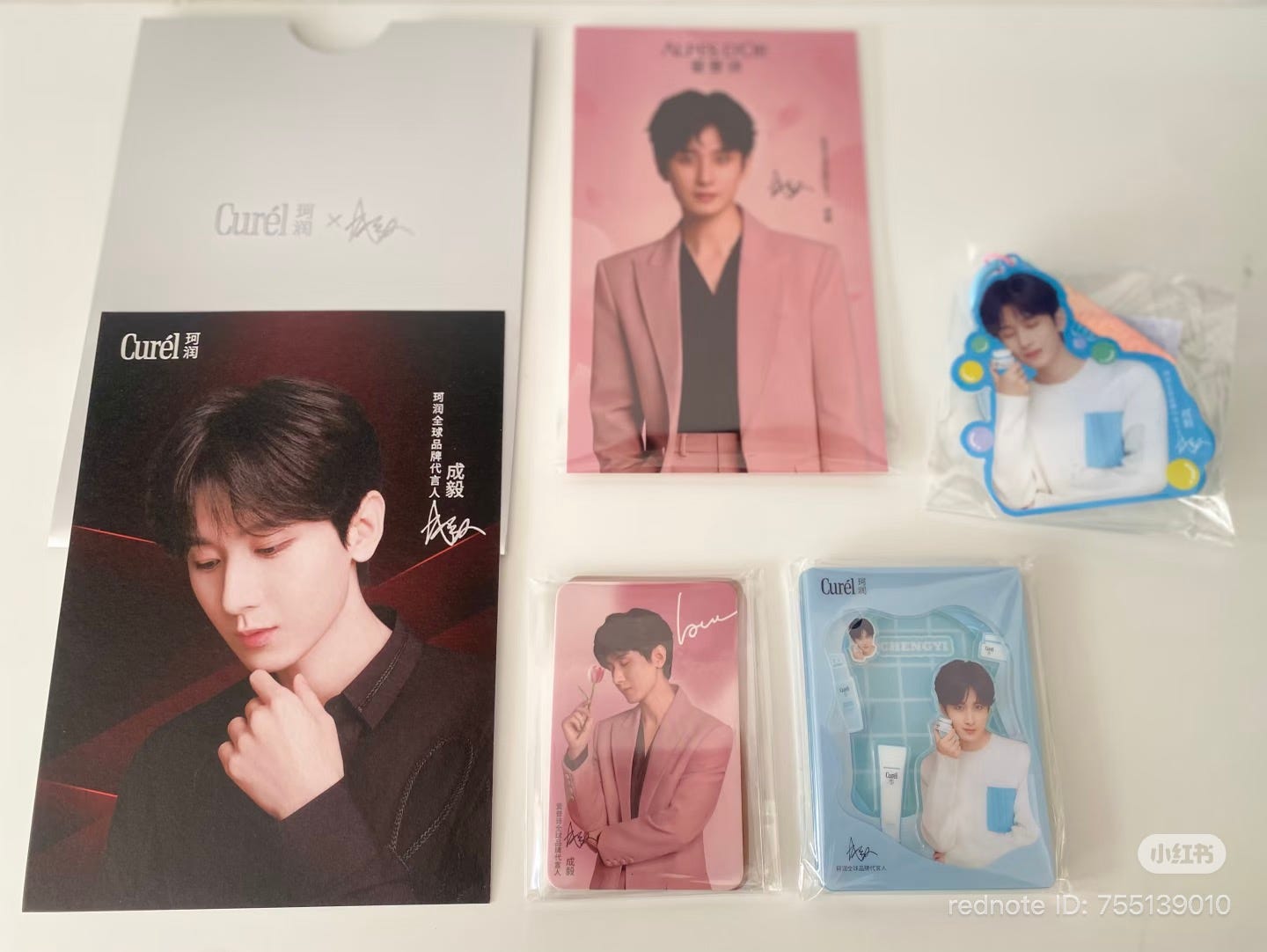
The first time I experienced the power of traffic star was after a couple of mundane e-commerce purchase. Along with my chocolate and face cream from two separate brands came with fridge magnets, postcards, bag accessory, all carrying a print out of a young male actor.
I thought these may be important to a fan, so instead of throwing it away, I posted on rednote saying that I’m happy to send it to whoever is willing to cover postage. I got swarmed with over a dozen inquiries within minutes: “I’ve been a loyal fan for two years, do you still have it?” “Still there?” “Do you still have goodies from Curel?”
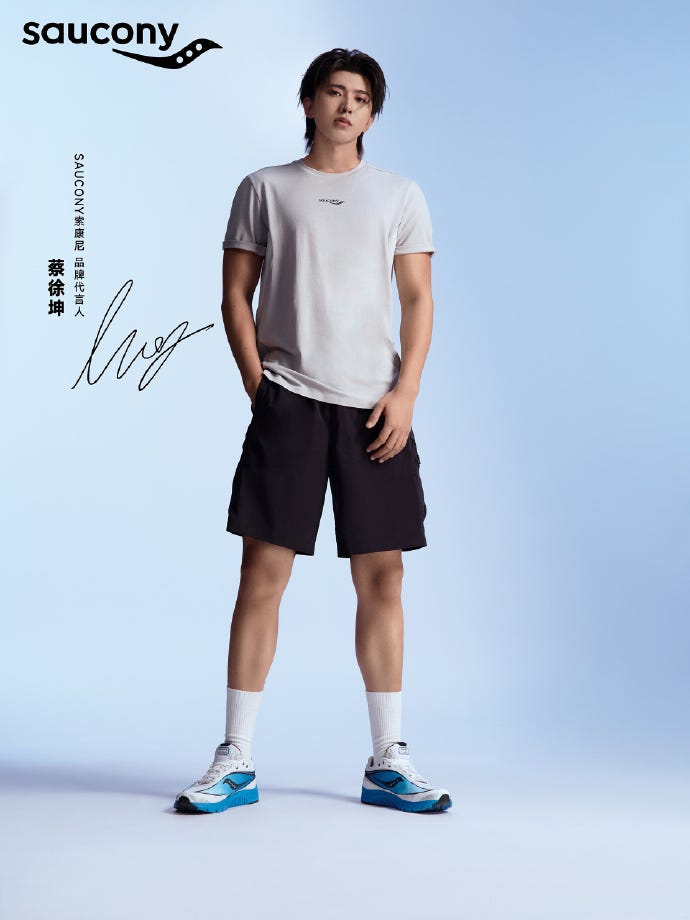
This experience came back to me when I saw singer Cai Xunkun on a giant Saucony poster in Shanghai this summer.
In the eyes of his fans, Cai is perfect and is gifted with both appearance and talent. Born in Wenzhou, Zhejiang province in 1998, Cai grew up in Hunan province and Shenzhen before moving to California for high school, he returned to China at 20 to compete in iQiyi’s ‘Idol Producer’ and won first place.
Almost 3 years ago, Cai was accused of pressuring a one-night stand to have an abortion, what was worse, the woman, named “Ms C,” also accused Cai’s mother of threatening her and hiring a private investigator to follow her. This incident immediately went viral online. A few days after that, state central television cctv.com deleted content related to Cai. Brands including Nestlé China, laundry detergent brand Tide and Yanjing Beer also deleted all of Cai’s social media content.
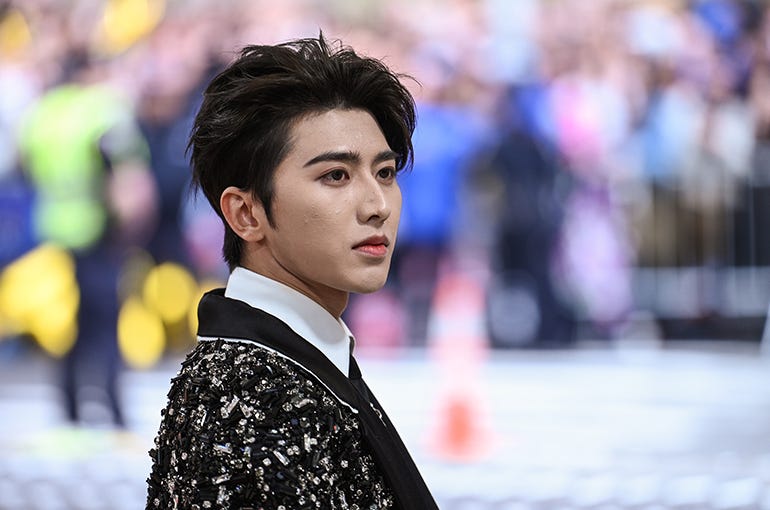
While in most cases, scandals at this level are usually responded within the day, he released a statement a week later, claiming that their relationship was “consensual throughout, the allegations that she was a minor or that she was coerced into having an abortion are entirely unfounded,” and that “no laws were violated.” It did not deny or mention his mom’s alleged behaviors.
Although the incident was settled, the erasure of his online content indicates that both central television and brands consider him to have crossed the line. It wasn’t outright cancelation like Kris Wu, the former Louis Vuitton ambassador who was sentenced of rape in July 2021, or Zheng Shuang, a former Prada ambassador, who had an illegal surrogacy scandal in January 2021 and was punished for tax evasion in April 2021.
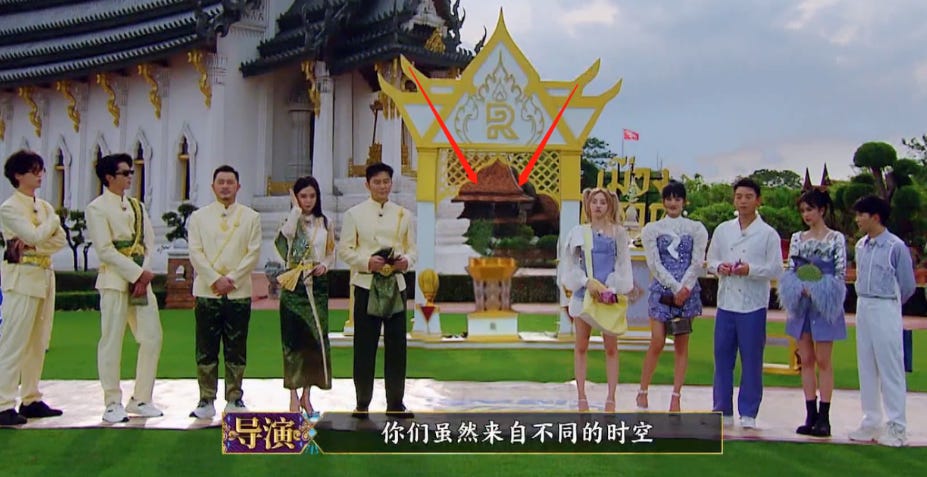
Netizens found it comical that the editors of Keep Running had to work overnight to edit out his presence (see below).
This case interests me exactly because it’s murky and elusive, and he combines the deciding factors brands are considering today as they choose a China ambassador.
What is ‘traffic’ star?
The term ‘traffic’ star first came out around 2010, when it still meant what it should be — mobile broadband traffic. Back then, people had to pay to watch American Idol-like shows including iQiyi’s ‘Idol Producer’, ‘Youth with You,’ and Tencent’s ‘Produce 101,’ which encouraged traffic from both viewers and voters.
Over the years, the backlash against such a mechanism attracted nationwide attention, and most of it has been negative.
One prominent case is the milk pouring incident in April 2021, when fans swarmed to buy the sponsor Mengniu’s milk products in support of their idols during Season 3 of ‘Youth with You’. They hired a bunch of people to work on the odd job — pouring milk down the drain and only keeping the caps — which resulted in mass food waste a few days after China’s Anti-Food Waste Law came into effect.

It touched a nerve of state media first. As on August 11, 2020, Xi Jinping issued a directive calling for an end to food waste.
After being condemned by state media and Cyberspace Administration of China, the traffic star phenomenon, fueled by the fan economy, went quiet for a while.
Around that time, the rise of celebrity scandals has made brands extra cautious, investing in due diligence and adding force majeure clauses to prepare for such events.
The Chinese Association for Performing Arts rolled out its list of moral guidelines for actors and performers in early 2021, which include “other situations that violate ethics or social order and good customs and cause serious adverse social impact.”
However, Cai’s case proves that in an attention economy where conversion overpowers all else, traffic stars become brands’ insurance policies.
A ‘Deadman’’s comeback
Having disappeared in China for almost 3 years, he started laying the foundation last year in the U.S. with his new single Deadman with renowned music agency 88rising.
And this year, he made a dazzling comeback to the mainland market, bagging ambassadorships from Japanese jewelry brand Tasaki, French running brand Saucony, British makeup brand Charlotte Tillbury, and a handful of domestic consumer brands. He attended Met Gala in early May with Charlotte Tillbury herself.
On Weibo, a platform seen as belonging to the past as users move onto more short-video-driven platforms, Cai still yields significant influence.
His posts on average garner over 1mn shares, over 1mn comments and over 1mn likes, the highest calibre that Weibo allows to showcase.
How does a traffic star differ from a regular celebrity, say, someone who’s known for their skills before their appearance? Actor Huang Bo, who has similar followers (~40mn) on Weibo, only gets hundreds in all above categories. Saucony’s other ambassador in China, Eddie Peng, gets thousands for the three categories in related posts.
In 2025, Cai’s law firm announced that he won the case of defamation against 2 bloggers and a girl (Ms. W) who accused him of having sex with the latter when she was a minor. Certain media and online users mistakenly conflate this with the earlier viral scandal, which involves Ms. C. It seems that not many people are bothered to corroborate the evidence and investigate.
And why does this French running brand ad catch my eye in particular? Well, Saucony is considered a serious brand that has sponsored many races around the world including 10Ks in London, Paris and Berlin, and half Marathons in Philly and London. They signed actor Kwon Hwa-woon, one of the top marathon runners in entertainment, to be the face of the brand in South Korea.


Does this new Saucony ambassador even run?
Cai has never been publicly associated with running races, except for his participation in Keep Running, a celebrity game show that has little to do with running.
It’s obvious to me how the information gap can be manipulated: he remains a traffic star with strong influence; he speaks good English; he was a regular cast member in a reality show called Keep Running. It makes perfect sense when HQs can’t be bothered to audit their ambassador’s past, or whether if the marketing campaign targets the right audience.
The Chinese internet environment helps, too, because so much information online is ephemeral — they can go ‘poof’ when the servers get shut down for cost saving, they can be deleted and altered.
High tolerance for male celebrities’ conduct
In February, 2025, viewers noticed that female actor Yao Di, who had been heavily promoted ahead of the variety show Actors Please Take Your Place 3, had been completely edited out of the broadcast.
It was the same treatment that Cai once received. Her offense? She was the other woman in beloved celebrity couple Ma Yili and Wen Zhang’s marriage over a decade ago.
While she remains in the public moral prison for good, male celebrities’ behaviors immoral behavior, including but not limited to cheating. has been largely tolerated.
In 2000, while being accused of having an illegitimate child, Jackie Chan held a press conference and told the world, “I just made a mistake that many men would make.”

In 2021, Wang Leehom’s ex-wife Lee Jinglei wrote an essay on Weibo detailing how he cheated and lied throughout their marriage. Five years later, he came back into the public eye as BYD’s global ambassador for its Denza series.
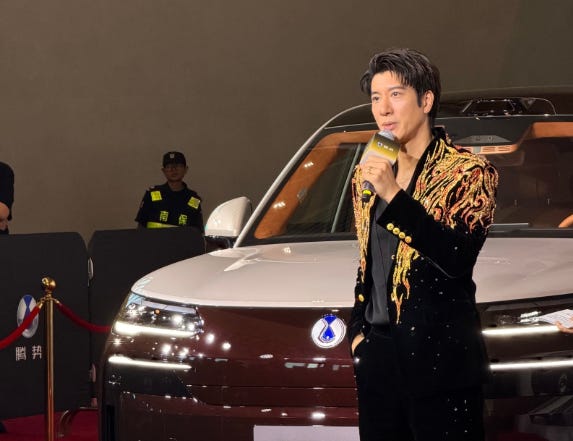
Even for Wen, who cheated on his wife when she was pregnant with Yao — made a back in theatre, his new noodle restaurant in Shanghai has been wildly popular.
China’s high tolerance for male’s immoral behavior has been deeply embedded in the culture of bigamy and concubinage, which has persisted for thousands of years.
Concubinage had only been expressly prohibited in 1950, when the Marriage Law of the People’s Republic of China came into effect on May 1, 1950. Hong Kong did not fully prohibit bigamy and concubinage until October 7, 1971.
Even with legal restrictions in place, it was difficult to completely reshape the social norms and customs. Structurally, it is assumed and socially accepted that male with heightened socio-economic resources do not have to abide by the monogamous marriage system, which is not only prevalent in entertainment but also business. Moreover, the legal system still has a lot of catch up to do in safeguarding women’s safety in domestic violence and sexual harassment cases.
As a result, many members of the public, including some women who have internalized this prejudice, do not see any fault in men cheating or making mistakes they are ought to make.
What decisions should brands make?
That becomes a problem as female consciousness rises in china. Especially among millennials and Gen-Zs, who were born into an environment after monogamy’s been widely recognized, and in the official narrative, they can ‘hold up half the sky.’ Therefore, female thought leaders and some consumers increasingly find the imbalanced moral standards unnerving.
I’m not advocating for a purity test, just a standard where women are treated as equals, men’s immoral behaviors are held accountable, and celebrities’ PR teams to stop treating the public like fools.
The story of Cai Xukun’s comeback reveals something larger, particularly in the context of his running-shoe endorsement, it reveals how brands increasingly view consumers through the lens of traffic.
In that worldview, a runner matters less than someone does not. A customer who buys a product because they trust it matters less than a fan who buys it because their idol endorsed it.
The priorities are reversed. This strategy will not work forever.
It may seem like an easy decision for us — but what do you do if most of your competitors are following the traffic-forward strategy? What would you do if you are tied to hardline KPIs and you know your non-Chinese speaking supervisor has no energy to scrutinize your work? What would you do if a traffic celebrity, despite being tainted by scandals, reciprocates you with at least 3 millions of combined likes, shares and comments in one social post?
What decision would you make? 🔚

The Saucony pick is the most revealing, they sponsor real marathons globally and signed a Korean actor who actually runs sub-3 hours, then chose someone whose only running credential is a variety show called Keep Running. The cognitive dissonance is doing a lot of work there.