

Over the years, I’ve written quite a lot about RedNote — the platform that Chinese millennials and Gen-Zs use for Ask-Me-Anything and sharing lifestyle tips, the platform that invested in public blockchain even as Beijing banned its applications domestically, the platform that gained hundreds of thousands of #tiktokrefugees earlier this year. Thanks to this last trend, it now hosts a mix of domestic and overseas users, dictates young middle-class consumers’ attention, and remains the most interesting digital ecosystem to watch in China.
In this post, I’d like to discuss China’s social progress that is happening in a commercial context, with many examples occurring on RedNote.
Why RedNote? Because of its commercial origin — started as PDF shopping guides for wealthy Chinese female consumers in 2013 — the social commerce platform hasn’t been taken seriously until recent years. In 2025, its user base is approaching 400 million, branching out to male and lower-tier cities. Still, its core audience remains female middle-class consumers in first, new-first, and second-tier cities.
I argue that RedNote’s commercial nature provides cover, that business takes precedence over everything else, so it’s ok to amplify certain messages to yield sales, and suppress others if they hurt business or bring political risks. What this brings is that both creators and brands and users knows where the boundary is — around marginalized communities, LGBTQ, feminist groups and ethnic minorities.
Here, I define social progress as raising awareness of the hardships faced by those from less privileged backgrounds, using one’s privilege to benefit those who can’t speak up for themselves, and rallying to push regulations forward.
Labor rights — The corn egg tart incident
In early May, a Douyin video featuring a female college student’s complaint about prices went viral. She entered a bakery and found out that a corn egg tart cost 28 yuan, she didn’t want it anymore and the shopkeeper gave her attitude. Later, she recreated the incident online and doubled down when netizens ridiculed her for being cheap.
“Why can’t I complain that an egg tart costs 28 yuan? Just because the price is clearly marked? Does clearly marking the price justify it being this expensive? Farmers work hard all year to grow wheat, and it sells for only 1.2 yuan per jin (500g)…”
After state media began taking her side, and many short videos appeared showing a transition from a corn egg tart to scenes of farmers toiling in the fields growing corn, with captions like:
"The corn I grew with my own hands… in the end, became a corn egg tart I can’t afford to eat."
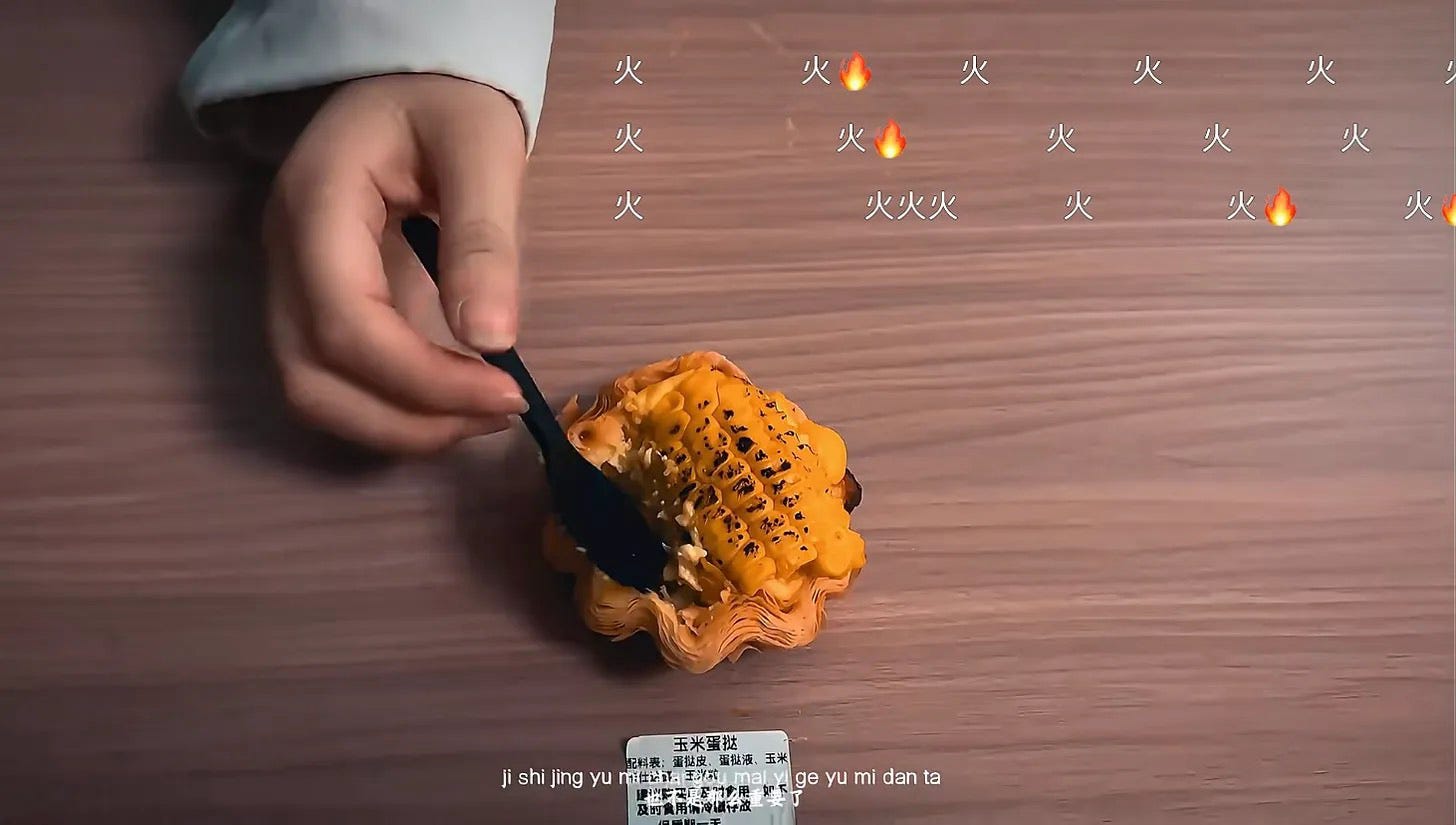
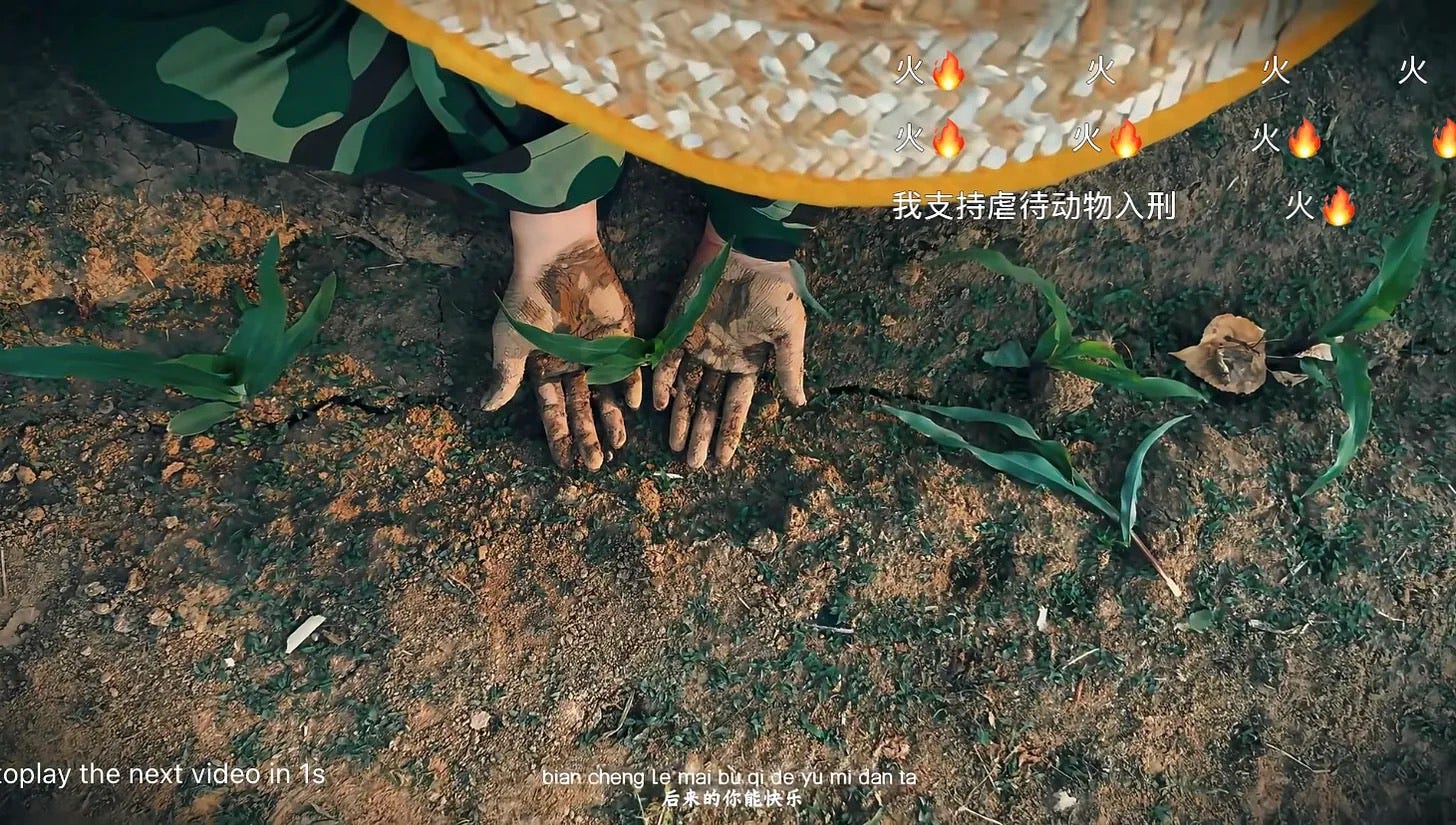
The larger context: This conversation didn’t originate on RedNote but on Douyin, and similar videos can also be found on WeChat and other platforms, but it speaks to the broader woke consumer culture that RedNote holds dear.
In non-commercial contexts, discussing social issues — such as the working conditions of senior laborers — is often seen as ill-intentioned. As I’ve noted multiple times in this newsletter, a 2024 NetEase mini-documentary titled “30 Years of Laboring Away,” which addressed the issue of senior migrant workers, was taken down across the internet after going viral. This is not just a Hefei issue; similar scenes are common in Henan, Guangdong, and beyond. Labor rights activist Wang Jianbing, 41, was sentenced to three and a half years in prison. He was convicted of “inciting subversion of state power” for hosting gatherings of workers with pneumoconiosis — a lung disease particularly prevalent among those working in coal mines — along with young activists and scholars.
The limitations of this topic are quite clear — the conversation abruptly stopped at the awareness level. A state media publication focused on rural workers shed light on the topic as well, but instead of diving deeper into their working conditions, it used the news as a hook and highlighted a positive example of how farmers benefit from smart farming.
Women's rights at workplace — Female cleaning staff in public bathrooms
Public advocacy from female users on RedNote for cleaning ladies in public bathrooms, including those in universities, malls, and street-side facilities, started in early 2025 and is still ongoing.
One of the earlier posts in March reads:
“I call for dedicated rest rooms to be established for cleaning staff —
What they need is a space that affords them dignity:
✅ 1. 24-hour hot water and lockers with locks
✅ 2. A foldable bed with a soft mattress
✅ 3. A first-aid kit and charging outlets
✅ 4. A microwave to heat up their meals
This isn’t a perk — it’s basic dignity.
As we sip coffee by the floor-to-ceiling windows,
let’s remember to leave a warm door open
for those who keep our cities clean.”
Another post in June reads:
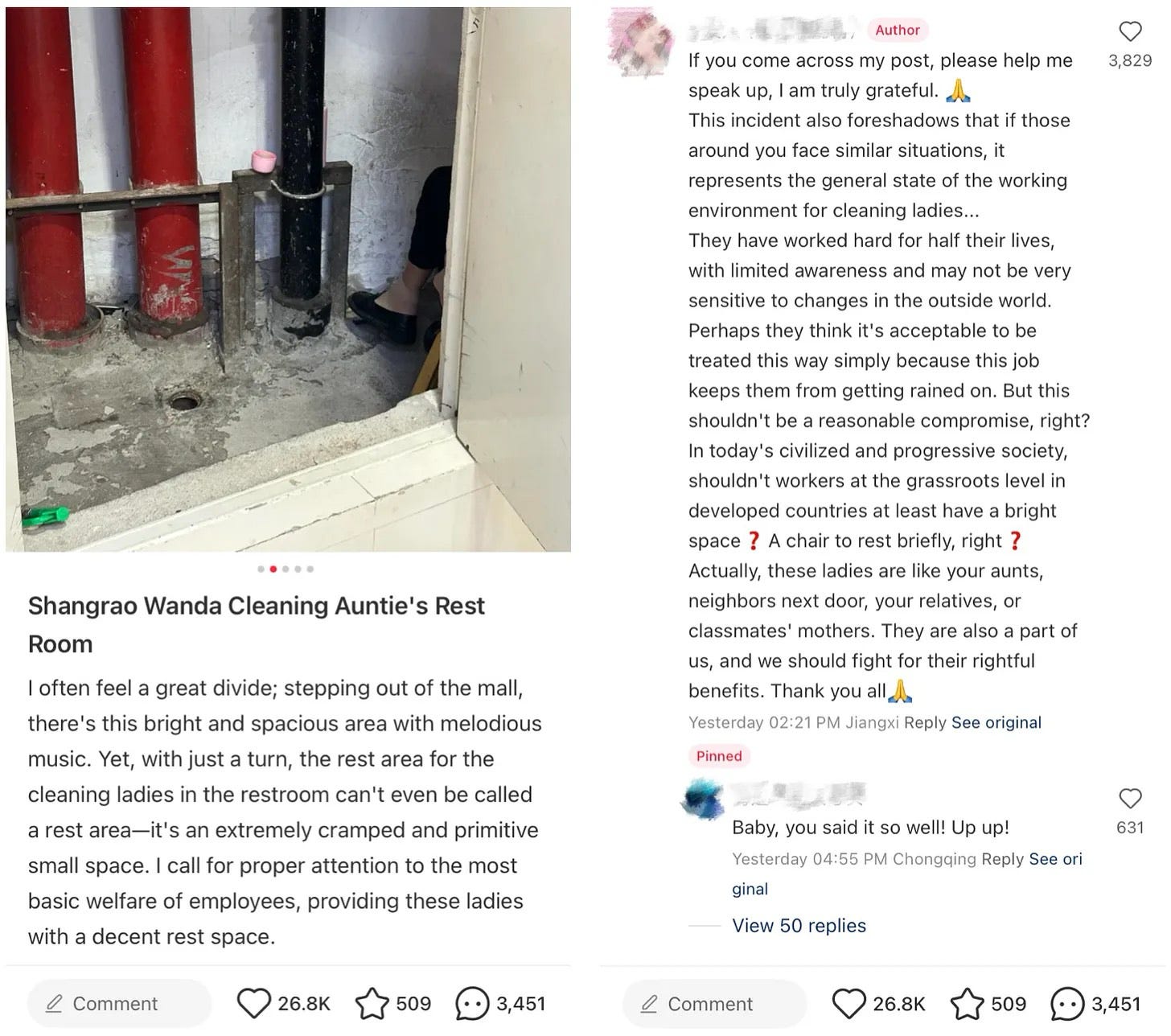
The larger context: Chinese feminists are often categorized as “Women’s Fist-ists (女拳)” — a term that, as documented by China Media Project, has been backed by state media as a way to “undermine legitimate discourse on women’s rights in China.”
The larger denouncement of feminism makes this RedNote advocacy one of the most well-thought-out and well-executed efforts I’ve seen, because it goes beyond awareness and feminist theory. It encourages consumers to recognize their own privilege and take matters into their own hands.
These users often document what happens after they take action — such as speaking with university supervisors or mall property managers — and it doesn’t always go well. Even so, these posts offer valuable trial-and-error lessons for others who want to follow suit.
Animal rights — delayed verdict of Westie Papi's poisoner
Many horrific animal cruelty cases come and go on Chinese internet in recent years: seven tons of frozen beagles were discovered in a garage in Henan, gutted and ready for sale after being lab animals their whole life, serial poisoning cases in Canto area and Shanghai, cat abuse in Zhejiang’s Quzhou, with the white cat’s four limbs were broken in public. However, they often end with no resolution in the public eye.
That’s what makes the RedNote user known as “Westie Papi’s Mom” so special. In the most prominent animal protection case to date, the owner of a 13-year-old Westie named Papi sued her 65-year-old neighbor, who had left poisoned food near a children’s playground — resulting in the dog’s death. Since 2022, she has refused to give up: she studied criminal law on her own and created content online to raise awareness of the legal gaps surrounding animal protection in China. Still, her latest appeal was delayed for the eighth time in June 2025. Nevertheless, her persistence has galvanized pet lovers and advocates across platforms.
The larger context: Despite years of advocacy by “Two Sessions” representatives, animal rights remain a low priority for the central government.
Companion animals are still classified as property under the law, which makes crimes like abuse or theft low-risk. While pet ownership is often celebrated under the banner of the booming “pet economy,” media coverage and industry analysis rarely address the legal shortcomings of a market that largely banned pets until the 1980s.
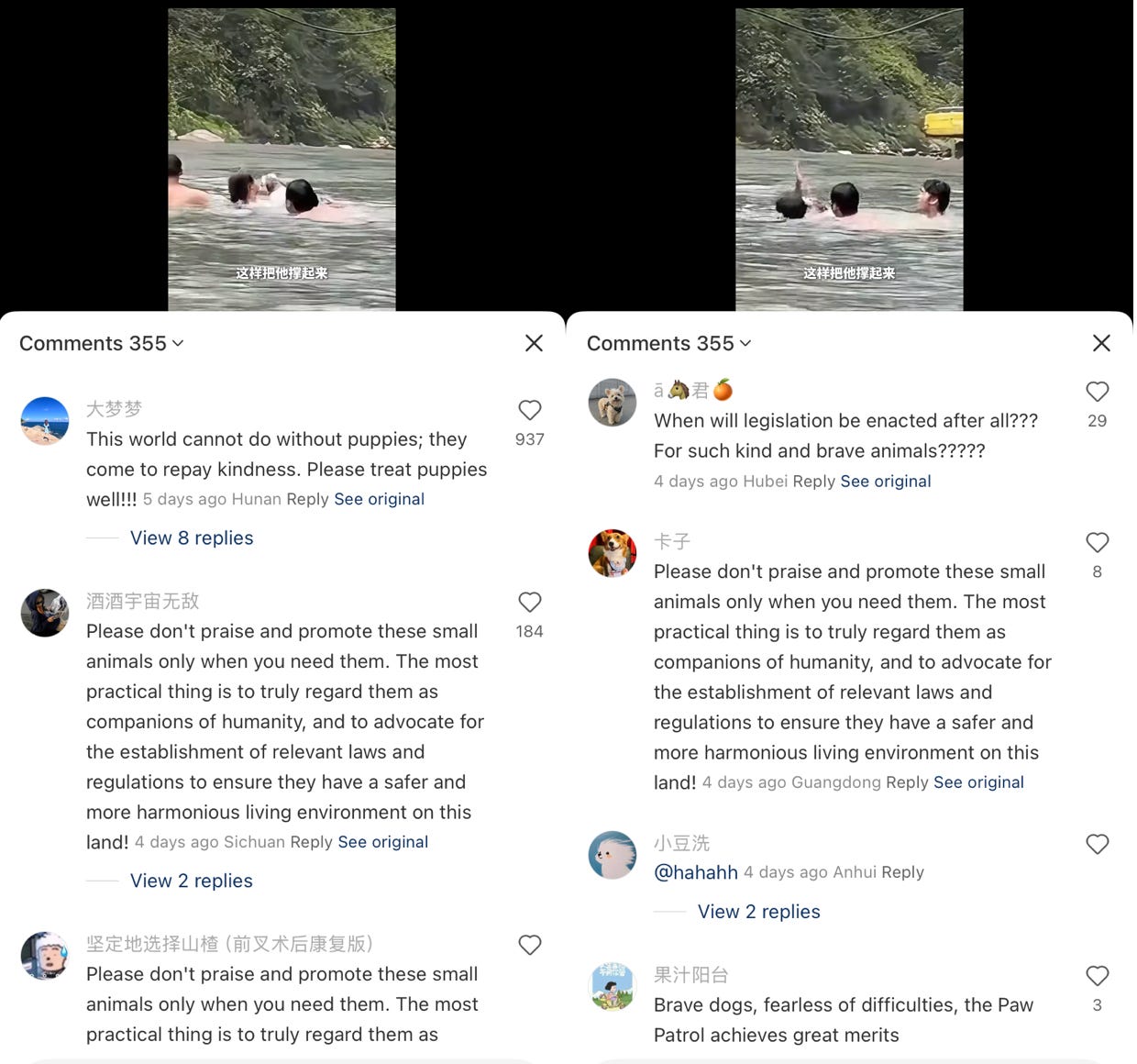
A good comparison of digital discourse can be found in the responses to a People.com social media post featuring a border collie rescuing someone from a river. On RedNote, users focused on advocating for animal protection legislation; on Douyin, the comments largely praised the dog but lacked this policy-oriented engagement.

A commercial context is a double-edged sword. While it offers a protective shield that enables conversations around social issues in China to take place more effectively, it also imposes limits on what actions individuals can take next. That said, I look forward to seeing more developments in the coming years. 🔚
#58: [special edition 🌱] Signs of progress in sex, mental health, and feminism in China | Following the Yuan

Happy new year everyone, I thought this would be a good week to shed light on some small positive developments in topics like sex, mental health, and feminism that happened to emerge in the first week of 2025.
perhaps the internet does have a liberalizing tendency, even if it isn't fully open