

Hi y’all, I’m flying back to London this week. While in China, I collected more materials for future [OOO] posts and connected with some of you. However, there is also an unexpected goal to spend the remaining credits I previously deposited at a pet store and through fitness membership platform ClassPass — and I didn’t succeed.
The sort of anxiety is increasingly common among Chinese consumers in post-Covid era as more businesses on membership models go out of business, amidst broader concerns like the curse of 35 at workplace, falling housing prices, unstable stock prices.
Meanwhile, we must also brace ourselves for unforeseen incidents, such as the tragic public violence cases reported this week.
I don’t mean to sound negative, but it both reflects the state of the news and the sentiment on the ground:
The most underserved people are agitated and protective of themselves. Those with means and options are retreating into their communities, hobbies, and personal well-being, while the powerful are cautious not to lose their control and their positions. Many people in China feel as if they have no choice.
Non-incidental public violence
A wave of troubling news from China emerged since last week: 8 deaths and 17 injuries from a stabbing rampage at a vocational college in Wuxi, Jiangsu province, two cars were driven into the crowds in Zhuhai (Guangdong province) and Changde (Hunan province), resulting in 35 deaths and 43 injuries, and “several” injuries, respectively.
There was limited time for (mostly foreign) media to conduct post mortems before facing harassment, while domestic media receives immediate hush orders and social media platforms started churning the censorship machine.
Like the recent series of stabbings targeting foreigners and Japanese children, we don’t know majority of the attackers’ intentions or how much they premeditated their actions. From the only workable materials, AKA police notices, the only consistent details are that the attackers are men, aged between their 20s and 50s.
These events aren’t isolated or incidental. Public interest demands answers: Why are these incidents happening, and how can we prevent them on a societal level? Yet, media is restricted from doing its job. What remains is collective anxiety, fueling self-defense classes and tutorials like “How to protect yourself when a car drives into you?”
The Stigmatized COVID Graduating Class
On Monday, the National Bureau of Statistics reported that in October, the unemployment rate for 16–24-year-olds was 17.1%. (This figure excludes current students and rural populations.)
After international scrutiny of June 2023's record 21.3% youth unemployment rate, Beijing successfully diverted attention by revising its calculation criteria last December. Or did they?
Behind these polished numbers lies a forgotten demographic: the COVID graduating class—a term for college graduates whose education was largely confined to online learning due to lockdowns. They endured the worst college experience, graduating into the worst job market in recent memory, only to face prejudices from recruiters. Some employers perceive them as unsociable, addicted to social media, impatient, and lacking professional skills.
A popular screenshot from job hunting site Boss Zhipin between a recruiter and a graduate encapsulates the situation:
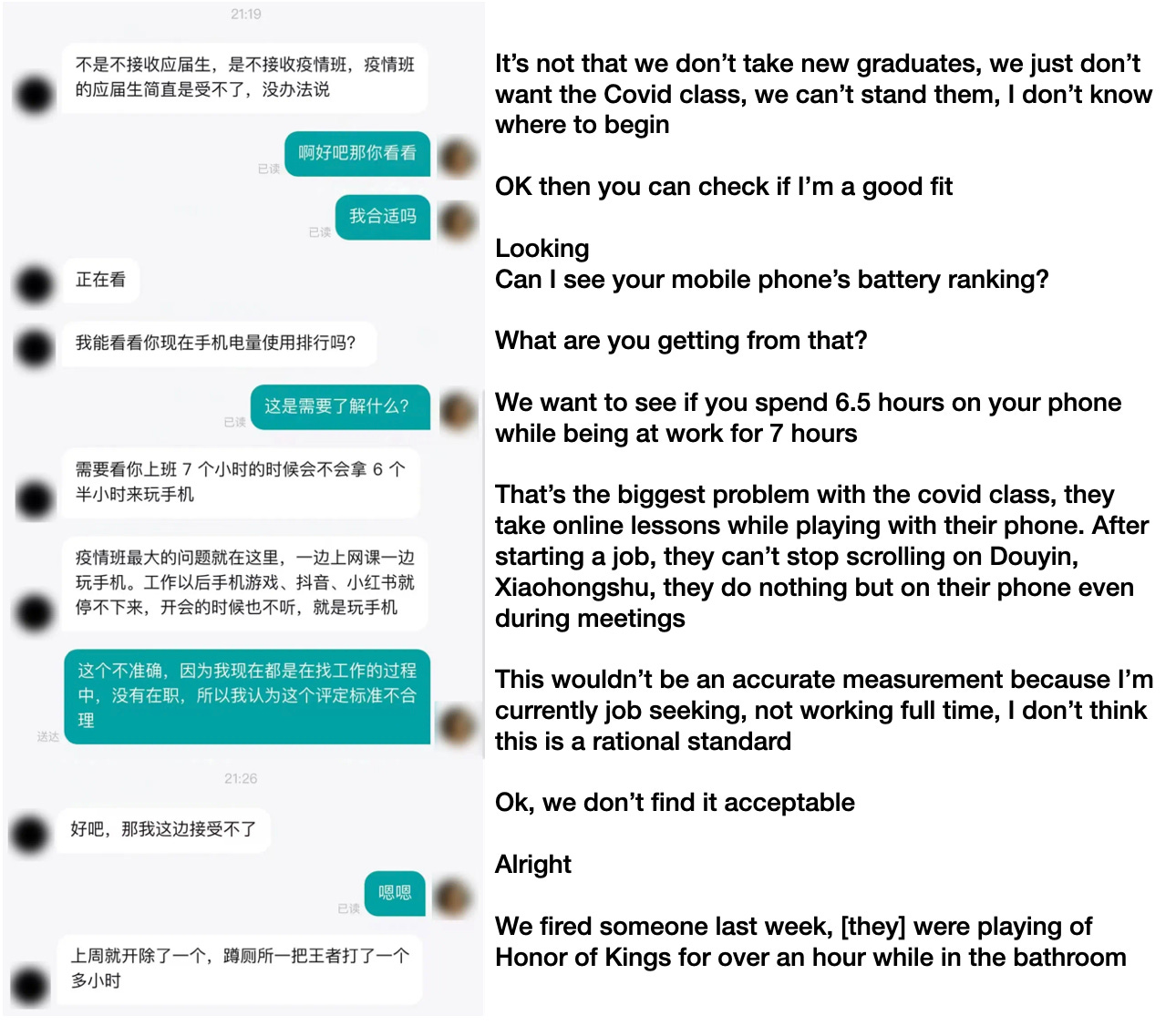
During the “golden September, silver October (金九银十)” job-hunting season, stories emerged of new graduates struggling to secure jobs. While several provincial level local state media from Sichuan, Yunnan and Zhejiang quickly published op-eds denouncing this growing trend, the effectiveness isn’t guaranteed. Like what happened to age or gender-related workplace discrimination, these recruiters could just learn to bury their discrimination instead of saying out loud.
The college graduates are encouraged to take off their scholarly robe, take on blue-collar jobs, and “eat bitterness”. It is under this kind of environment that some of them also feel defeated.
The society needs more entrepreneurs and more jobs.
To address this situation, the education arm would have to recognize and be transparent about the unemployment problem, and revamp the system to be less force-fed and create more entrepreneurs for the society. However, in the foreseeable future, I believe that the reliance on state-owned employment would grow, and the mismatch between talent and opportunity would only continue.
Clampdown on emotions
Last Friday, two of China’s largest bike sharing programs Meituan and Hello Bike paused operations in Zhengzhou of central Henan province, the capital of central Henan province and the city where the cross-city cycling trend began earlier this month. Social media users reported few sightings of Didi Bike, but it’s uncertain if all residents can start riding again.
Here's a timeline of how the phenomenon unfolded:
June: Four college students took a 50km bike trip to Kaifeng for soup dumplings. They got interviewed by local TV after sharing the experience on socials.
November 2-8: On Nov. 2, Thousands of college students followed their route by the second round of local TV coverage . Encouraged by the local culture and tourism bureau, several tourist attractions in Kaifeng waived ticket fees for colleague students in general during this period. Millennium City Park, a Song Dynasty-themed park, even offered annual passes to cross-city students who traveled by bike. Nov. 8 saw over 100,000 cyclists — mostly students — rode to Kaifeng. That was the peak of the phenomenon.
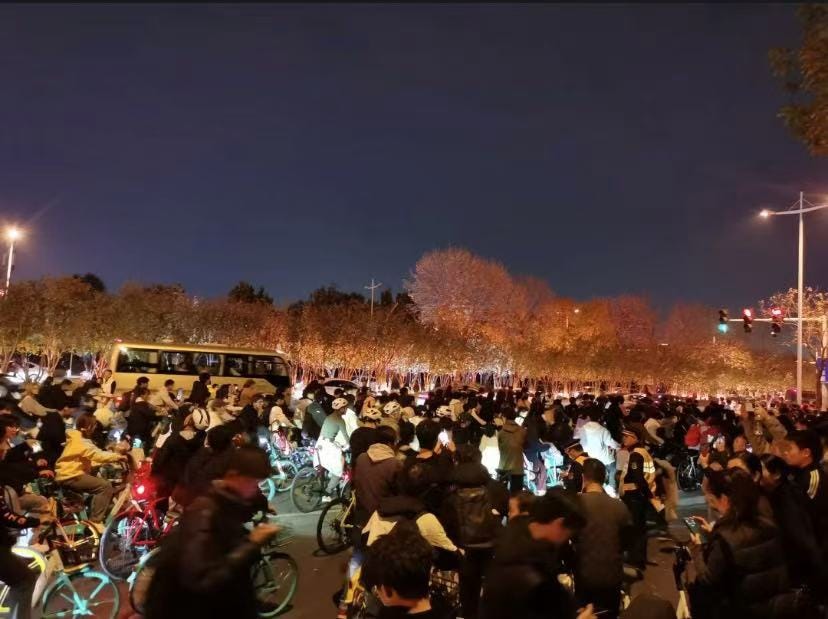
November 9: Restrictions began. As the city with the second-largest college student population in China after Guangzhou, Zhengzhou saw several universities enforce lockdowns to curb the movement. Bike-sharing programs implemented measures like automatic bike locks to prevent travel beyond city limits.
November 15: City-wide stoppage of bike sharing operations.
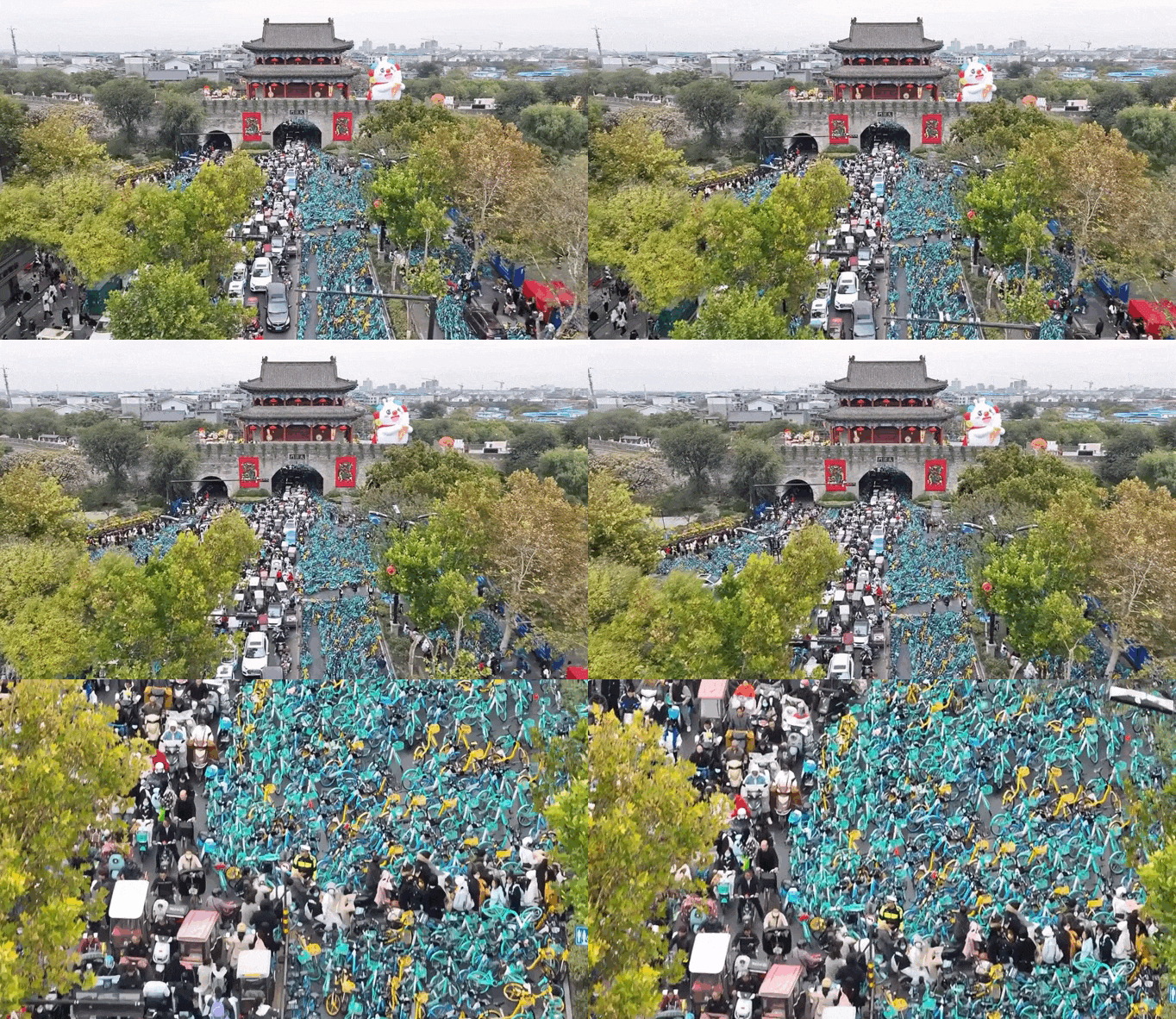
This incident highlights a pattern in highly surveilled societies: when people seek emotional outlets, they turn to commercial activities and platforms, because the latter allows more space. In this context, bikes became a vessel for these emotions. A few weeks ago, halloween costumes were a vessel.
Such activities are not always political. There were slogans like “I’m only young once”, and participants quoting standup comedian Fu Hang’s favorite line “Passion!”. Students carried flags with messages like “Freedom, I’m coming on a horse” and “No fear for a free spirit”, alongside patriotic expressions: “China should unite and must unite” and Chinese flags.
How people want an emotional outlet is universal, especially when it was encouraged by the local authorities.
This is special force tourism 2.0, a term that captures how Chinese college students spend as little as possible to travel, but has more to do anxiety of local governments (every piece of booming local tourism you read about Zibo BBQ 淄博烧烤, morning markets in the Northeast 东北早市, Tianshui Malatang 天水麻辣烫 has fed into their anxiety and action).
From Halloween to riding bikes, the seemingly mundane things are being put to an end because officials are highly paranoid about anything that would stir up collective emotions — like what white-paper movement did in late 2022. This is making China increasingly like a high pressure cooker. And the opposite side of the coin is non-incidental accidents that, unfortunately, may continue to happen. 🔚
Last question/words: Cycling cross-city may be an emotional outlet for some Zhengzhou students, what’s yours?
Next week, I’m looking to publish an OOO (field notes) and a personal essay, and in the first week of December, I’m looking to announce some trends that I believe will shape 2025. Please tune in!