

China’s tech giants have found their next bet for the AI consumer gateway: hardware.
ByteDance began selling its second-generation Doubao phone on September 16, starting at 5,999 RMB (about $845). Tencent isn’t building devices itself, but it has co-branded eight hardware products with partners, all plugged into its AI workplace platform WorkBuddy. Huawei released its first AI glasses in April, priced from 2,499 RMB (about $350).
Of all of them, Alibaba is placing the most aggressive bet.
In March, Alibaba folded its scattered AI businesses into a single business group, ATH (Alibaba Token Hub), all under the Qwen brand. Qwen now sells AI earbuds, AI glasses, an AI recorder card, an AI desktop companion, and an AI computer. Every one of them runs on Qwen’s large models, with agent services provided by QwenWork. The hardware is the entry point that drives token consumption — and the outline of a full AI consumer ecosystem is starting to take shape.
In late September, Alibaba hosted its three-day Apsara Conference, its flagship annual AI industry event in Hangzhou. Together with more than 1,000 companies, it filled over 50,000 square meters of exhibition space and drew more than 100,000 visitors on day one alone.

There, Following the Yuan mainly experienced two kinds of AI hardware. The first is Qwen’s in-house lineup — earbuds, glasses and more — which captures how Chinese AI hardware is typically conceived. The second comes from other brands at the conference: niche, often playful products like a pet-language translator and an AI “life memory” camera.
We hope they expand your imagination of what AI hardware could be, as they did with ours.
👓 Qwen AI earbuds and glasses (prices: TBA)
Qwen AI earbuds can record and translate; the AI glasses do all that and can also take photos and handle payments. Say “Hi Qwen” to wake the device, then tell it what you need: “record this,” “start simultaneous interpretation,” “what kind of flower is this in front of me?”
The data is uploaded to the cloud for processing, and your interaction history is stored in the companion app, where you can look back through it whenever you need.
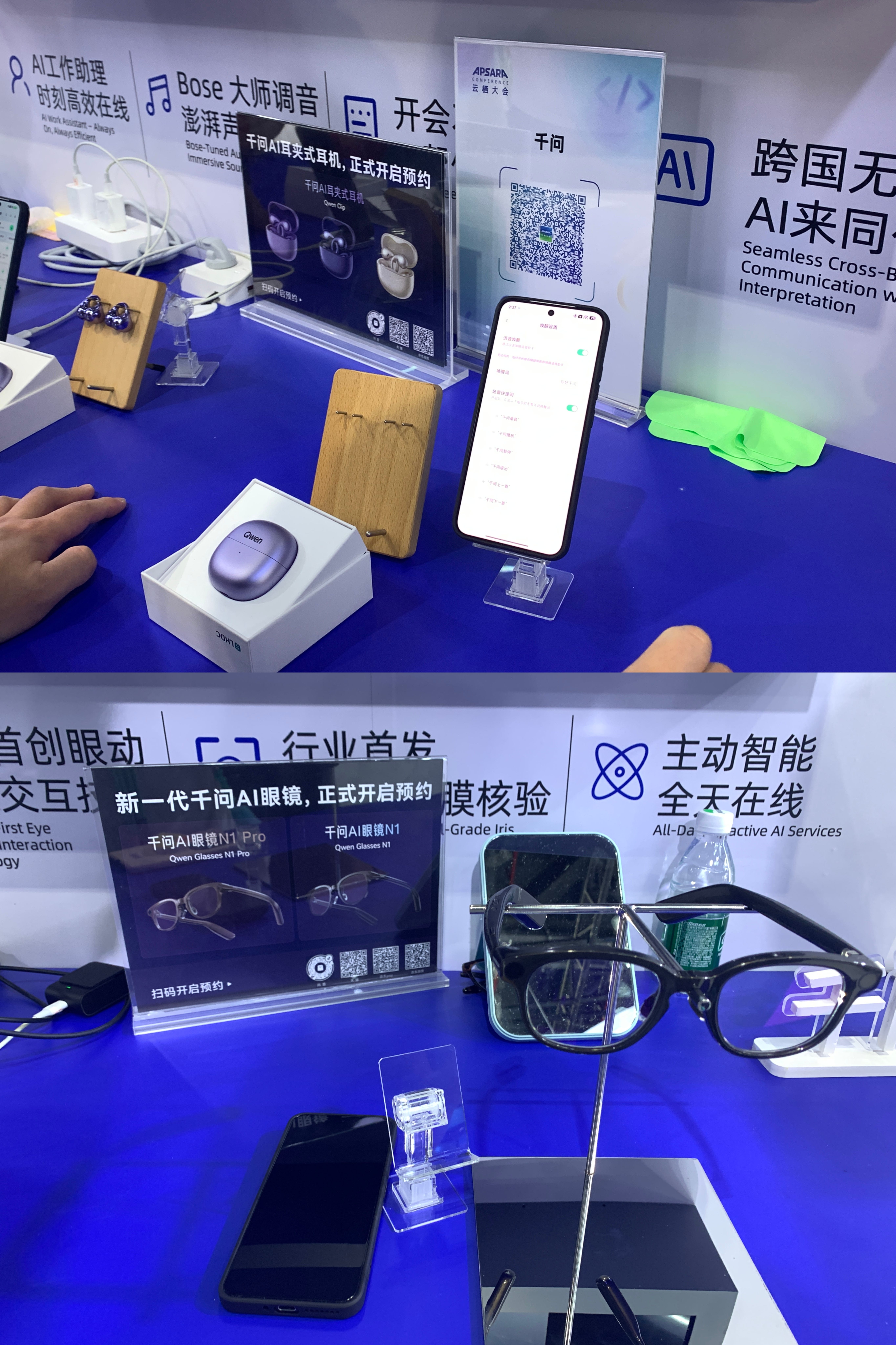
The basic logic behind AI hardware becomes clear: things you used to do by tapping through your phone, AI now does in one step. Want to record something, snap a photo, or figure out what song you just heard on the street? Normally you’d pull out your phone and open the right app. Now AI takes care of it on the spot through earbuds or glasses.
“The reason we’re making hardware is to expand where AI can be used,” a staff member at the booth told us. “At first, AI was only for chatting. Now it can get things done on a computer. So the next step is — can it carry out tasks in the physical world?”
🗣️ QwenNote Eva (899 RMB) and QwenNote A2 (1199 RMB)
Next up are QwenNote Eva, a desktop robot, and QwenNote A2, an AI note-taking device, both of which are supposed to shrink the gap between having an idea and acting on it.
QwenNote Eva requires you to dock your phone on it, which will turn it into a little desktop robot or an embodied agent.

