

This has been a good month for both investors and viewers of Mango TV. After the reality show I Miss You (后会友期), about long estranged friends, began airing, viewers (myself included) have been waiting for its Thursday episodes and gossiping about them on social media. Meanwhile, 2bn RMB had been added to its owner Mango Excellent Media’s (300413) market value within 5 trading days in early November.
The show is a Mango TV original that has been compared to the network’s earlier hit See you Again (再见爱人), a reality show about celebrity couples on the brink of divorce.
In I Miss You, the four pairs of old friends drifted apart for different reasons.
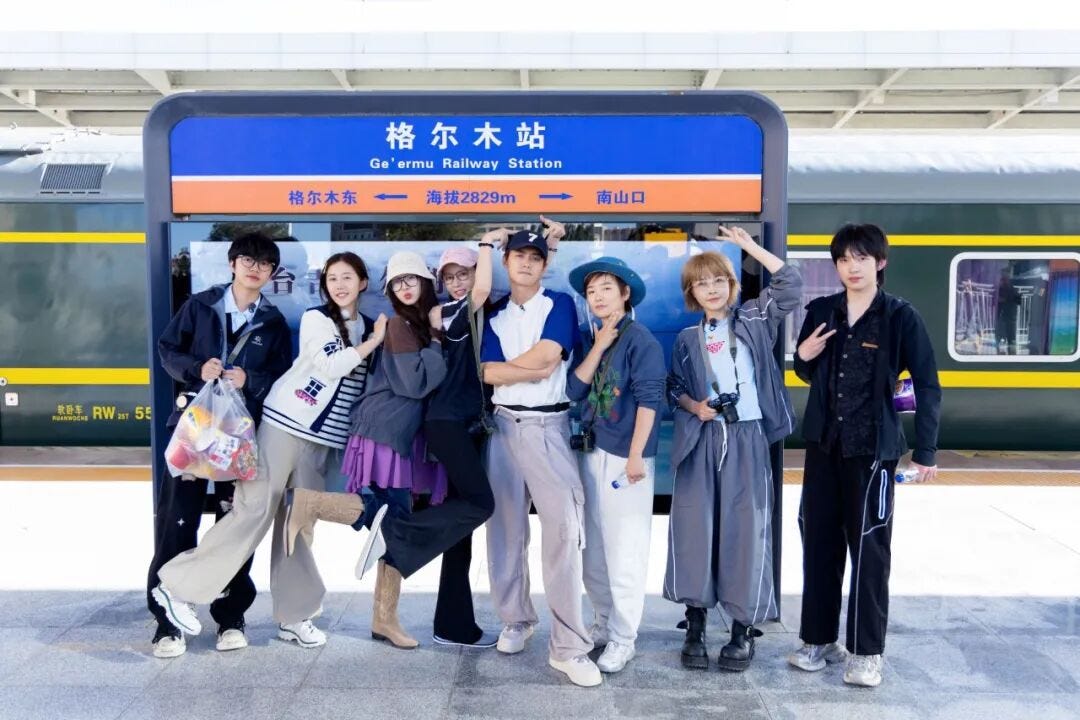
Singers Xu Fei and Li Na have been cut off from each other by lingering resentment over a suspected jubao. Producer Zhang Meng and singer-actor Ma Tianyu lost touch for years because of a misunderstood text. Qing Zhi and Bai Xiaochun went from best friends in eSports to rivals. The friendship between Writer Wen Jier and actress Wang Zixuan became tangled up with money. They take a fresh look at their friendships during an 18-day journey through high-altitude Tibet.
This week, the producers of Mango TV launched a new casting call: finding estranged bosses and subordinates who want to reconcile, which is yet another creation of its estranged-relationships series. It’s clearly become a winning recipe.


In this piece, I want to discuss what made I Miss You successful from a sociological and business perspective, and whether its success is repeatable.
Social: trust is expensive
Making up with friends is rare in a heavily populated nation immersed in jubao culture and lacking a culture of ‘the benefit of the doubt.’
Jubao — to report (wrongdoing or wrongdoers) to the relevant authorities. Modern Chinese Dictionary
The closest English translation is reporting. Both the official definition and the English term imply following a formal process, but in practice, most common cases of jubao are ideology-based and emotionally driven.
Jubao is a scary thing that makes people paranoid and fear of sharing secrets or even personal facts with one another. The Cultural Revolution (1966-1976), a period of heightened political correctness, exacerbated the collective mindset of “you always need to be on your guard” (防人之心不可无, from the Ming dynasty author Hong Yingming). Sharing one’s personal opinion on current affairs, even with immediate family members, could lead to jubao and result in fatal consequences.
Today’s jubao culture runs deep on university campuses. A recent article, since censored, depicted how far students would go to fight for the scarce quota of Master’s at their own universities:
Some students deliberately keep their distance from classmates from their first year onward: they don’t joke around with their roommates, don’t make friends with others in their own class, and don’t readily voice opinions…
Complaining that military training is too exhausting, spending money freely, or posting a WeChat Moments update about celebrating Christmas can all be screenshotted and used against them. — Midnight Sun Studio under Sohu News, via China Digital Times
Non-fiction writer Peter Hessler, who taught at Sichuan university between 2019 and 2021, wrote about his experience being the victim of a very public jubao in his New Yorker piece “A Teacher in China Learns the Limits of Free Expression.”
The benefit of the doubt: the state of accepting something/someone as honest or deserving of trust even though there are doubts. (Merriam Webster)
The idea of ‘the benefit of the doubt’ originated in English courts and was later adopted into everyday use. China’s absence of ‘the benefit of the doubt’ can be partially attributed to its legal history, in which the common practice is guilty until proven innocent. By contrast, Western legal systems are built on the presumption of innocence.
As someone from China, who learned the phrase and its meaning later in life, I believe that this could largely benefit all four relationships, especially that of Xu Fei and Li Na’s. The pair first met each other on Hunan TV’s Super Girls 20 years ago, and then signed the same company, before Li believed that Xu told management about her private gigs. They hadn’t spoke for over a decade before the show.

In the most recent episode that aired on Thursday, they’re still fighting about to whom Xu Fei reported Li Na’s prohibited conduct. If Li ever gave Xu the benefit of the doubt, I thought, she might still get punished, but their ending as friends would look different.
Not giving others the benefit of the doubt is a defense mechanism in a resource-stricken society, and many viewers can relate to it. The latter have poured their heart and soul into analyzing these four pairs and manifest their make up (other than the pair Wen Jier and Wang Zixuan). It’s a phenomenal sight in China’s entertainment industry that is reminiscent of how Taiwanese singer Cindi Wang’s appearance helped boost Mango Excellent Media’s stock price by 10% intraday on May 24, 2022.
Mango TV’s ability to tap into this pain point and turn it into a successful show can be attributed to its company culture and its roots.
Business: why Mango TV?
Mango TV has been long overshadowed by the two major Chinese media systems: the archetypical state-media and media ventures started by internet giants. State media is rigid but it has control over discourse. Internet media, be it streaming platforms or social media accounts, is known to be more relevant and better at marketing.
In 1997, the provincial broadcaster Hunan TV began broadcasting nationwide by satellite. Its first hit show was Happy Camp (快乐大本营), a show I grew up with, featuring anchors He Jiong and Li Xiang and a different set of celebrities every Saturday night.

The show arrived two years after Beijing started the two-day weekend scheme when China’s economy had been seeing annual GDP growth of around 8-9%. That was when Chinese consumers first had real disposable time for entertainment in recent decades.

Later on, other provincial TV stations, such as Jiangsu TV, also produced hit shows such as Special Weekend (非常周末, 1998-2010) and If You Are the One (非诚勿扰, 2010-present).
But their relevance dissipated gradually, especially after streaming platforms like iQIYI and Tencent Video entered the scene in the early 2010s. Zhejiang TV’s Keep Running (奔跑吧, 2014-present) has been a national favorite, but it struggles to produce anything else as widely recognized.
It’s always a top priority for such TV stations to catch up with the internet age, and an industrywide structural reform led by President Xi Jinping was getting under way at the same time. In 2014, he officially called for the industry transformation of “media convergence” to ensure that content is “collected once, generated in many forms, and distributed through many channels.” It makes it easier for Beijing to control public discourse but also makes the content look homogeneous.
Hunan TV’s story is slightly different. It is not the only one that can make hit shows but it’s the only one that has stayed relevant through industry reform and be able to outcompete market-driven platforms. Hunan TV created the Golden Eagle website in 2004, which later changed its name to Mango TV in 2014. Since then, the two sister companies have become interchangeable in the Chinese public perception.
A former director of Mango TV told podcast Straight To The Point, the secret sauce of their competitiveness is its internal talent scheme. Employees are encouraged to submit their own proposals to produce shows, which is how, for example, the celebrated See You Again (再见爱人) came about in the first place.
