

It takes less than $150 to customize a miniature camera into your phone, glasses, water bottle, lighter, remote control, or sneakers. Common spy equipments have never been so accessible, thanks to China’s manufacturing power in consumer electronics.
They could be installed on any objects, and appear everywhere in China — public transportation, hotel rooms, homes — in the most recent #maskpark incident, they are used to take creepshots of Chinese women and girls.
To join #maskpark on Telegram, which has reportedly been disbanded, one must submit video/photo of women around them. The content was mostly of sexually exploitative nature and was secretly filmed, according to witnesses who were interviewed by Southern Metropolis Daily. The domestic outlet did the most in-depth investigation that has been cited by Guancha, Sixth Tone and several other state media in China and international outlets including Reuters and The Guardian.
This is a problem far bigger than 100,000 users. Public response to the scandal sheds light on the echo chamber surrounding gender issues in China, the seemingly unkillable gray market for pinhole cameras, legal loopholes, and more.
“Just wait for the birth rate to drop to 0%”
Last Friday, when #maskpark began trending on Weibo as a result of Southern Met’s report, female-centric social platform Rednote was flooded by copy and paste comments to show solidarity and resistance:
“If it’s this easy to capture women’s private moments, then it must also be easy to capture military secrets and national defense facilities. (要是这么容易就能拍到女生隐私,后来拍到军事机密,国防设施也是很容易的。)
“You can choose not to investigate — and we can choose not to give birth. (你们可以不查 我们也可以不生。)”
“If [you] don’t address this, just wait for the birth rate to drop to 0%. (再不处理就等着生育率降为0%吧。)”
The very social group who are being targeted, and who are acutely aware of their omnipresence, took to the internet to demand official attention. However, rather than directly advocating for women’s safety, they feel compelled to attach their cause to issues of China’s strategic importance: espionage and birth rate.
This communication tactic is anticipatory of what Beijing’s priorities are and what’s not: issues that mainly concern women.
What seems ironic is that on July 28, Beijing officially announced the birth subsidies for households of up to three children: 3,600 RMB/year for each kid under the age of three.
(I don’t think anyone can say for sure where China’s birth rate is headed. However, I don’t think the group that feel appealed by subsidies and those making the above statements are the same group. For many women in China, whether or not to have children is not their decision, and some may not think that the lack of autonomy is unusual.)
A gender echo chamber
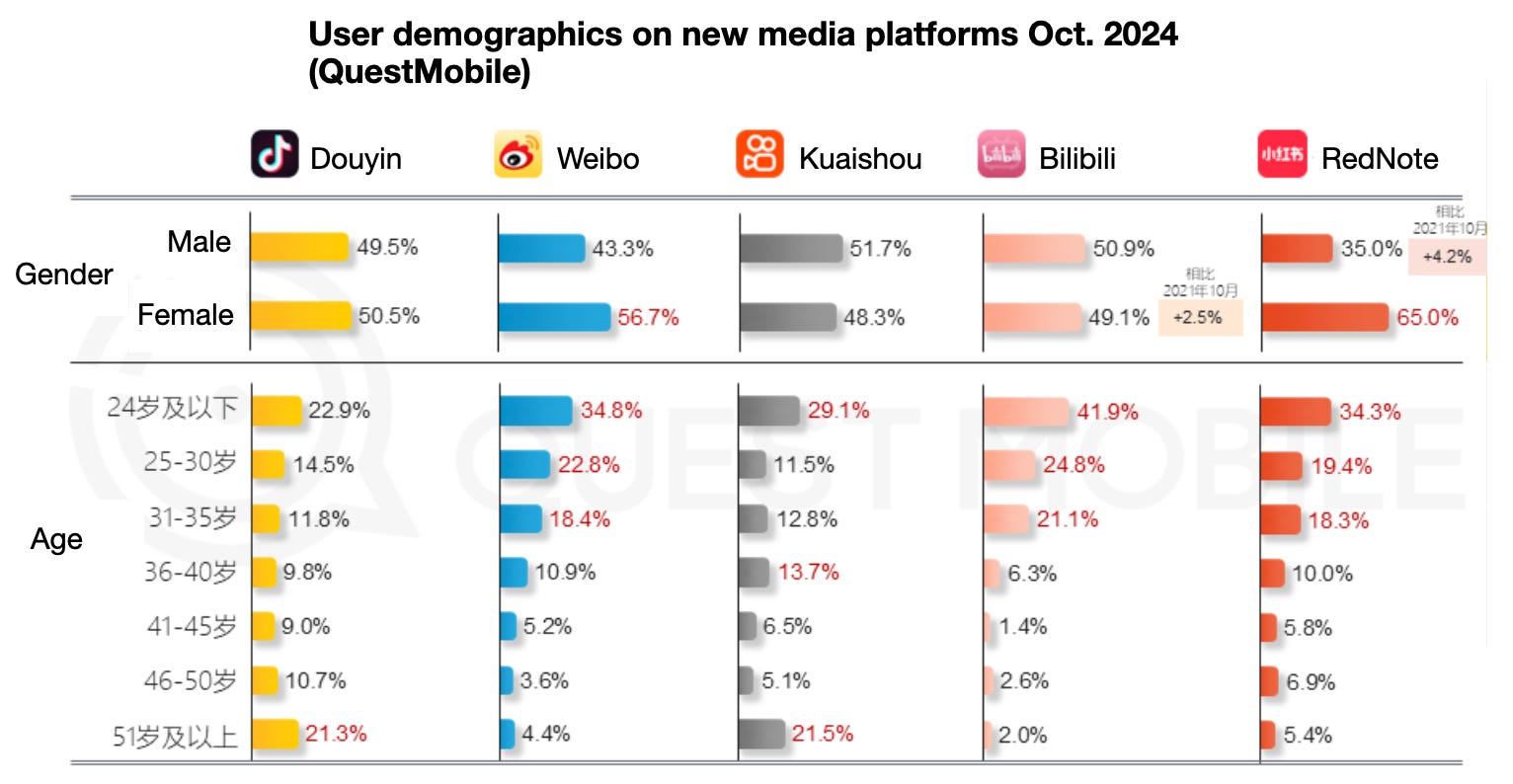
On Rednote, the social commerce platform with over 300 million monthly active users, conversations around Maskpark are the much more progressive compared to WeChat, Weibo, Douyin, Bilibili and Kuaishou.
According to third-party data intelligence platform QuestMobile, Douyin, Bilibili and Kuaishou have a relatively even gender split of 50%/50%. Weibo’s male to female ratio is around 43%/57%, whereas on RedNote, there are only 35% male users and 65% are female users.
Beyond gender, more implicit factors such as socio-economic background and education-level also come into play. Rednote users are considered highly educated who predominantly reside in tier-1 and new tier-1 cities, the #tiktokrefugee trend also brought in a wave of English-speaking users from around the world, which is unprecedented for any Chinese social media.
While WeChat and Weibo, essentially China’s news portals, feature mostly articles from state media about the incident, the tone on other platforms noticeably skews male. On streaming platform Bilibili, the top video by search results said female were too “well protected” and were “emotionally manipulated” to think MaskPark is a big deal.
On Kuaishou, top 3 comments under a popular post with 56k likes read:
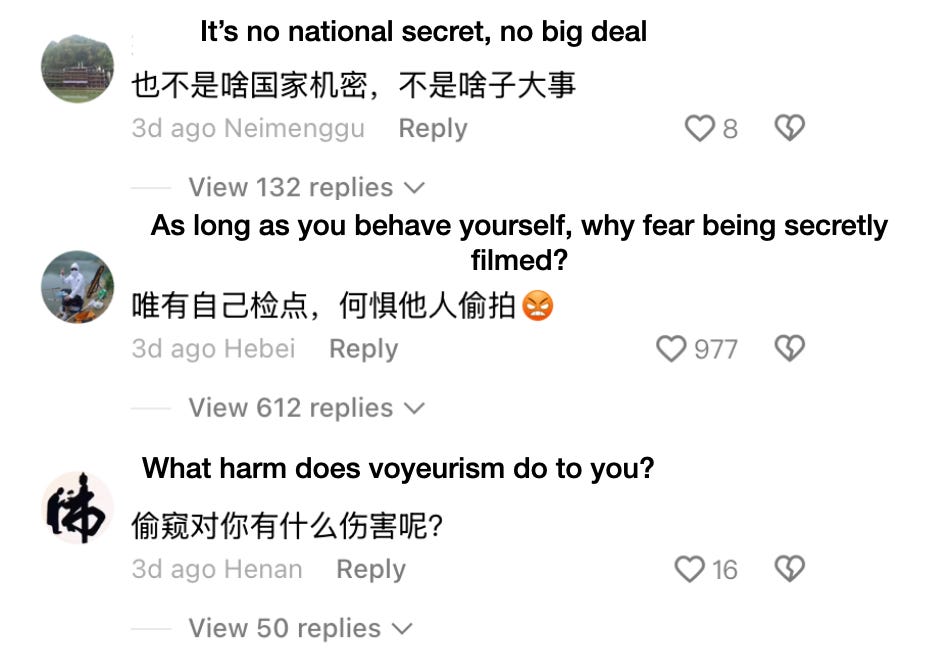
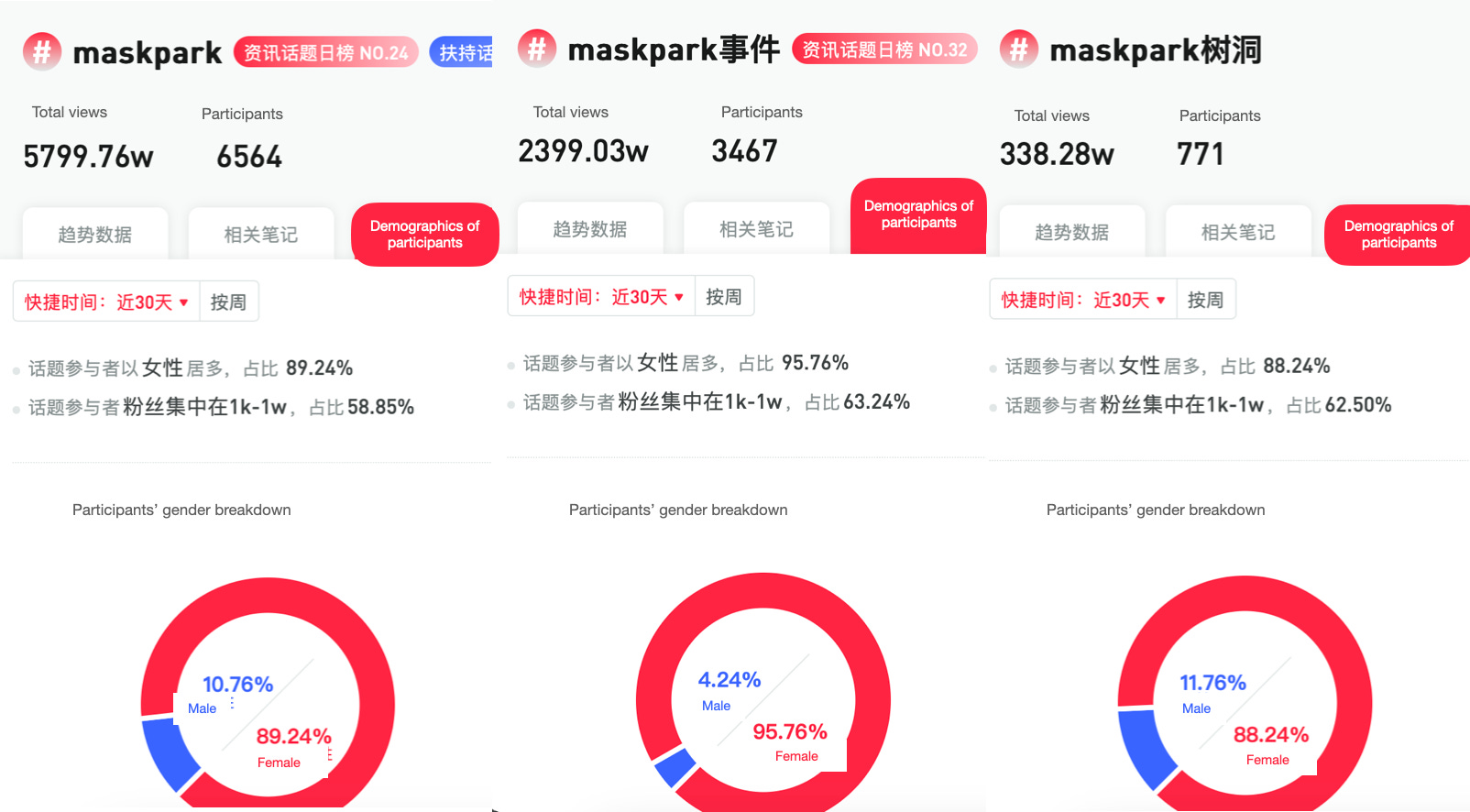
With that in mind, the gender split of those who posted about Maskpark on RedNote is astonishing, yet expected.
The female participants of the top three relevant hashtags are between 88.24% and 95.76%. They use the hashtags to advocate for awareness of nonconsensual voyeurism on the social level, and in-depth investigation and legal advancement on the government level.
It looks like these two groups on Rednote and Kuaishou are speaking to each other, but it remains a question whether they can hear each other.
This disconnect is a microcosm of China’s deeper societal divides, especially around gender.
Ever-evolving tech VS outdated law
Technology shouldn’t be blamed but the activity of secret filming also hinges on the cheap, accessible pinhole cameras and China’s advanced internet environment.
“In 2005, during the 3G era, devices for secret photography are of the size of a wine glass, they did not have a widespread effect because of internet limitations,” He Zhihui, an executive of an information security and protection firm, told Sanlian Lifeweek in 2024. “But around 2012, with breakthroughs of 4G and wifi signals, the pinhole camera industry also took off.”
I downloaded the short videos below featuring a shoe, sockets, fan and glasses, from Telegram pinhole camera sales group. The handle of this group contains the Pinyin word Toupai (secret photography).
It’s merely impossible to determine the size of the pinhole camera market, especially after a 2021 crackdown by four ministries including The Cyberspace Administration of China, the Ministry of Industry and Information Technology, the Ministry of Public Security, and the State Administration for Market Regulation. From May to August that year, they arrested 59 suspects, intercepted 1,500 sets of audio and video equipments and closed off nearly 4,000 accounts on e-commerce platforms such as JD.com, Taobao and Xianyu. That is when the sector went underground.
The product or the usage of pinhole camera in sex crimes is not new. Similar devices and tactics are found in Taiwan’s Creative Private Room case, which involves child sexual abuse and child pornography, and South Korea’s Molka cases (where pinhole cameras were described as ‘spycams’).
China’s law hasn’t caught up with the advanced tech, even as cases of nonconsensual voyeurism nature happen more frequently in recent years.
In 2019, when a Shenzhen female customer found a pinhole camera in a Uniqlo dressing room in 2019, the person who installed it, a male engineer, only faced 10 days in administrative detention under China’s administrative punishments law.
“In cases of pure voyeurism, no criminal offense has been committed,” Qu Zhenhong, a lawyer at Beijing Huayi Law Firm, told Sixth Tone then. “Only if the footage is distributed can a case be considered under the crime of disseminating obscene material (for profit).”
The public hasn’t seen any updates of relevant law since.
Hotel businesses and the economy may pay the price
Hotels aren’t the only scenario where secret filming or nonconsensual voyeurism happens, but they are one of industries hit hardest by something like MaskPark and similar incidents.
Female consumers will not stop staying in hotels, but many now heightened anxiety after the increasingly frequent hidden camera media reports. Hotels are expected to safeguard their customers’ privacy, and they have to compensate the customers in case of any breach, according to China’s consumer law. Many hotel chains have taken the blame — including Hanting in 2018 — though hotels’ names sometimes do not get mentioned in the press under mutual agreements. The phenomenon or anxiety around it is so widespread, that a Shanghai Hyatt Regency even posted safety tips for guests on how to check if their rooms are camera-free.
It can be a sizable operation for hotels to procure equipment and train staff to surveil every room, it can be costly to cover compensation as these case numbers rise. If hotels hire private security companies, the average price is 150 yuan per square meter in Beijing. Disputes between the hotel and customers could also add operational burdens.
In a society where installing pinhole cameras and secret filming have little consequences, the victims, who are predominantly female, but also include men, are the ones left traumatized and shamed, and the venues are the ones who pay the price. That should not be the case.
Beijing recognizes female spending power, and expects them to continue to drive economic growth. In 2021, a UBS report projected that in most optimistic Female Empowerment scenario of US$5.3trn incremental household consumption growth between 2020 and 2030, 80% of that growth would be driven by rising income among Chinese women.
It’s so paradoxical to urge women to “buy buy buy” and give birth to three kids when their very basic rights aren’t protected — when they must watch out for “a shoe, umbrella, crutch” in public transportation, as the above information security expert suggests. And even when they find the courage go to the police in the case of unwanted advances or illicit voyeurism, such acts not considered a crime.
Here I do want to admit — and I hope you forgive me — to make the title more sensational to bring more attention to the MaskPark.
I wonder: do you now see the logic of the RedNote users? 🔚
Resource kit (to be continued)
This month, I’ll be releasing a resource kit that compiles media reporting and studies from the past 20 years on related cases across East Asia — including China’s societal views on sexual harassment, South Korea’s Nth Room case, Taiwan’s Creative Private Room (involved customized content of raping underage girls), and mainland China’s “Little Cabbage” case (involved coercion and sexual assault of underage girls), as well as the recent MaskPark incident.
One wonders what Tesla does with it’s cameras…