


Welcome back! “China color” is a column that records Chinese people’s unfiltered voices, as well as field trips by our contributors. You can read all the previous issues here.
Almost exactly two years ago, China stopped publishing youth unemployment data, which had hit a record-high rate of 21.3% in June 2023. It’s back six months later, calculated with a different set of metrics, excluding students in school. For June 2025, it was 14.5%.
We began to see the Chinese government mentally preparing for the increasingly tough job market years ago, especially in 2023 and 2024, encouraging the youth to “eat bitter” and “strip off their scholar's gown.” A recurring theme of news stories like “Delivery Guy Earns 1.02 Million in Three Years to Repay Debt” and “Young People Become Renovators, Earning 40,000 a Month” also appeared during that time.
On the topic of youth unemployment, Chinese state media and statisticians both had to do their jobs—cherrypicking positive stories and downplaying negative data, respectively.
Chinese businesses, such as People’s Bank of China and recruitment platform Zhaopin.com, whose data were previously cited by Goldman Sachs, stopped publishing in late 2024.
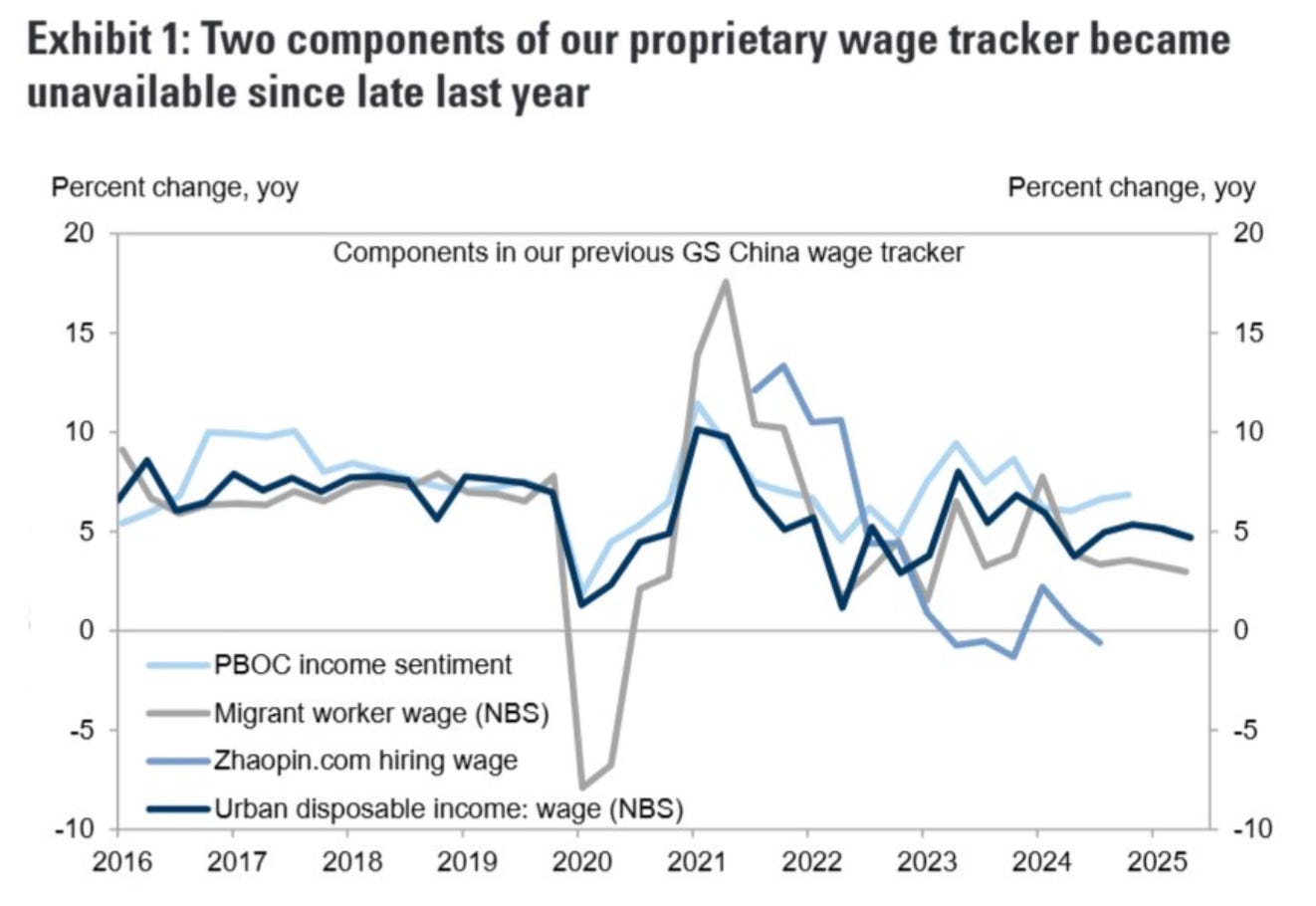
The pattern has resulted in a huge discrepancy between the official perception of the job market and the one people are experiencing.
Apart from masked numbers, we feel the need to show how the youth are really feeling—through self-deprecating memes, journals and conversations in the comments section. So, here’s what the issue is about.
1. Available job opportunities do not require higher education
An education graduate ends up selling mice poison in dialect.
A medical student ends up being a masseur.
A hospitality graduate ends up being a waiter.
The customer who’s rude to the waiter is an influencer.
By comparing their envisioned future at graduation versus the reality, the comedy skit shows how graduates are reacting to the tough job market with humor and exaggeration (similar to the ‘lie flat’ culture). But there is also a certain amount of truth in it.
Shandong user Tiantianniao’s video, featuring her looking exhausting while take the subway, reads: “Given the current job market, universities don’t need to offer a wide range of courses anymore, just four will do:
Livestreaming and group live-streaming, civil service and graduate school exam prep, customer services and operations, and delivery and courier services.”
It has nearly 90k likes.
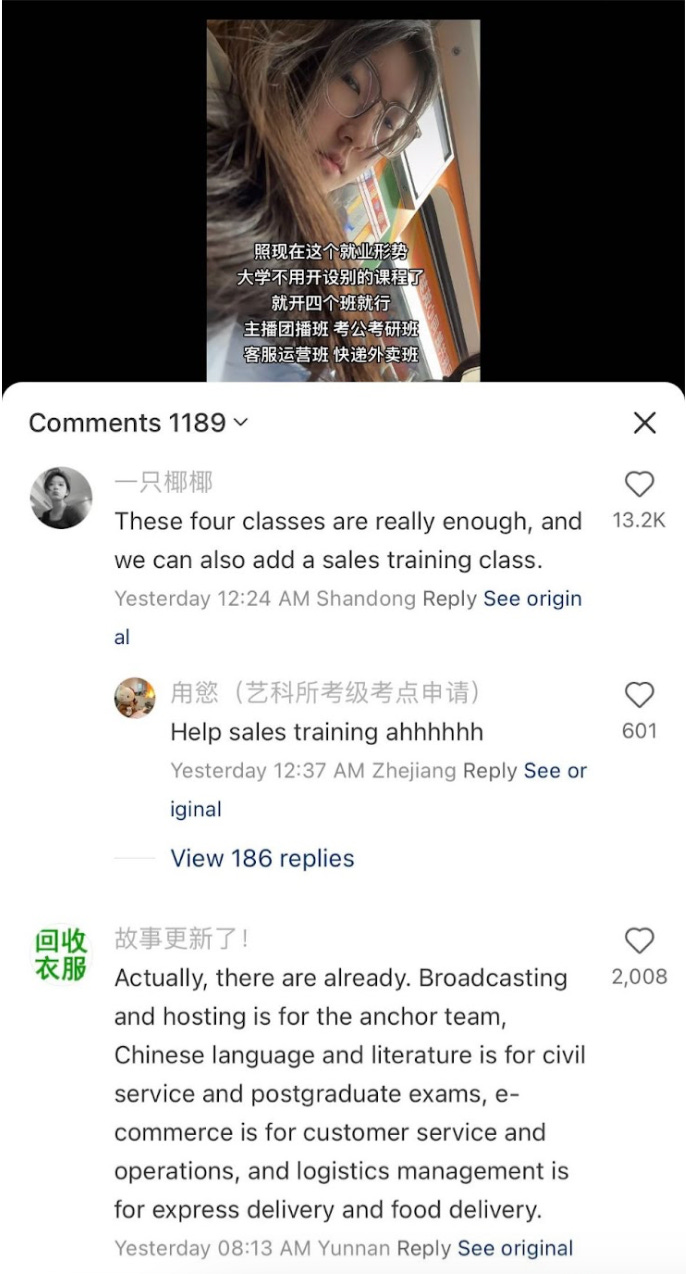
Below, Asia-focused youth publication Radii also noted ‘group livestreaming’ as an emerging career choice for Chinese graduates.
2. 985/211, overseas degrees are now useless
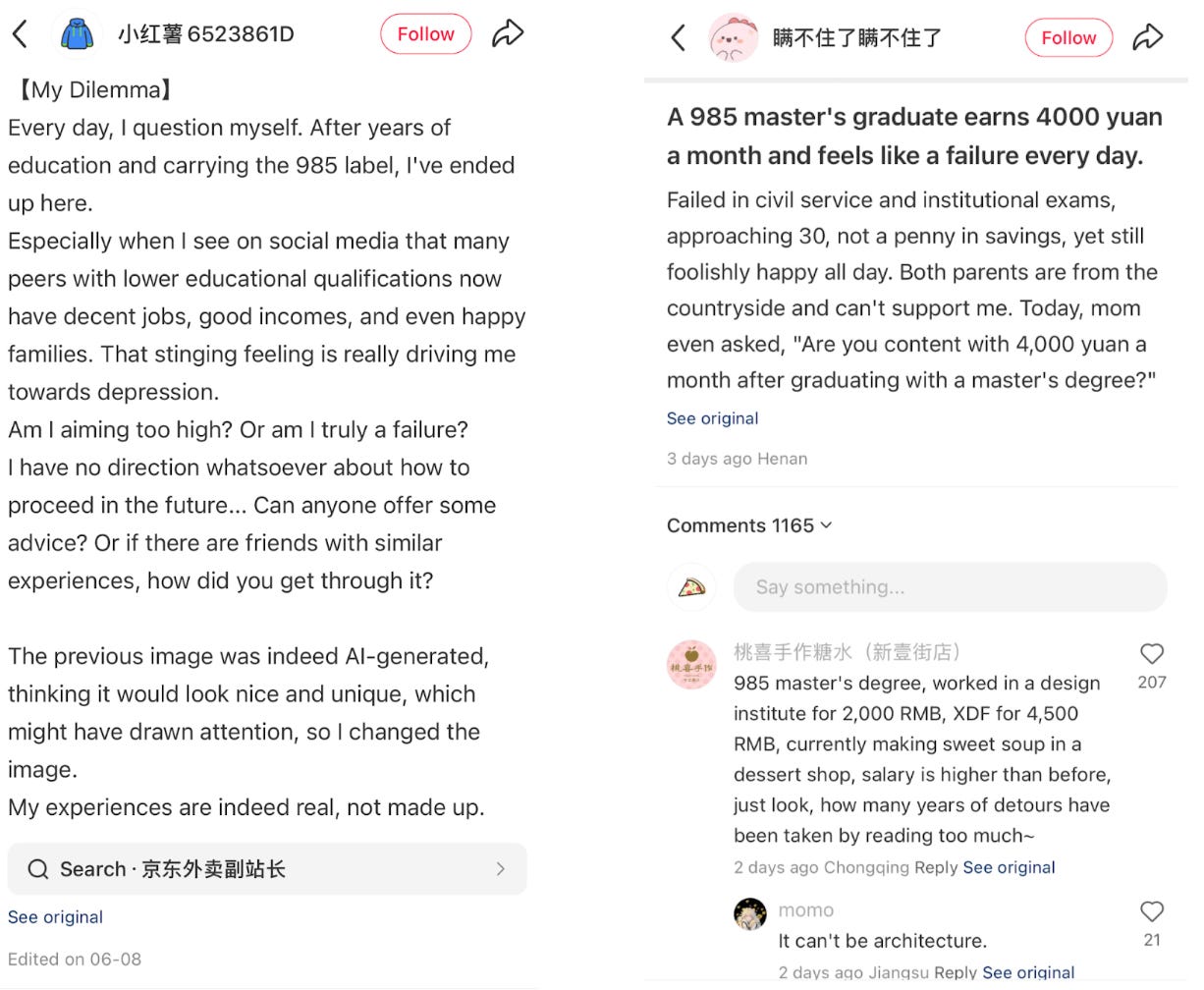
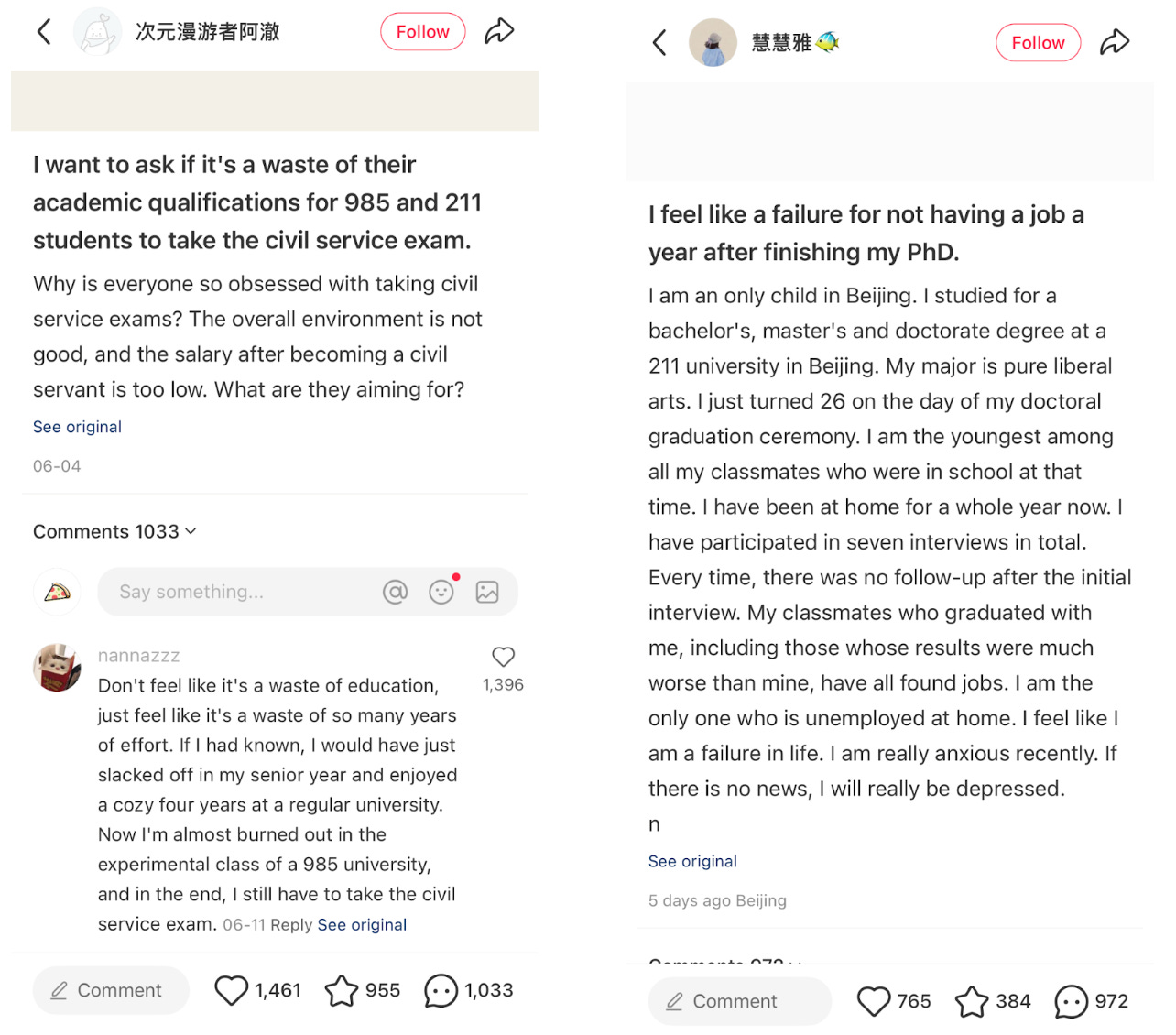
Just as many graduates are unable to match their courses/majors with their jobs, they also find that the conventionally competitive credentials from being part of a project 985/211* university within China, or having overseas degrees, has lost much of their perceived value.
[*Project 985 and 211 were both initiated in the 1990s by the late former president Jiang Zemin as higher education development and sponsorship schemes. 985 is considered more competitive than 211.
Although China’s Ministry of Education nullified the policies in 2016, and these two projects have now been integrated into the “Double First-Class (双一流)” initiative. However, the perceptions remain.]
It gives them an identity crisis, as the notes below explain:
This Shaanxi-based overseas philosophy graduate below posted a group picture and shared its backstory:
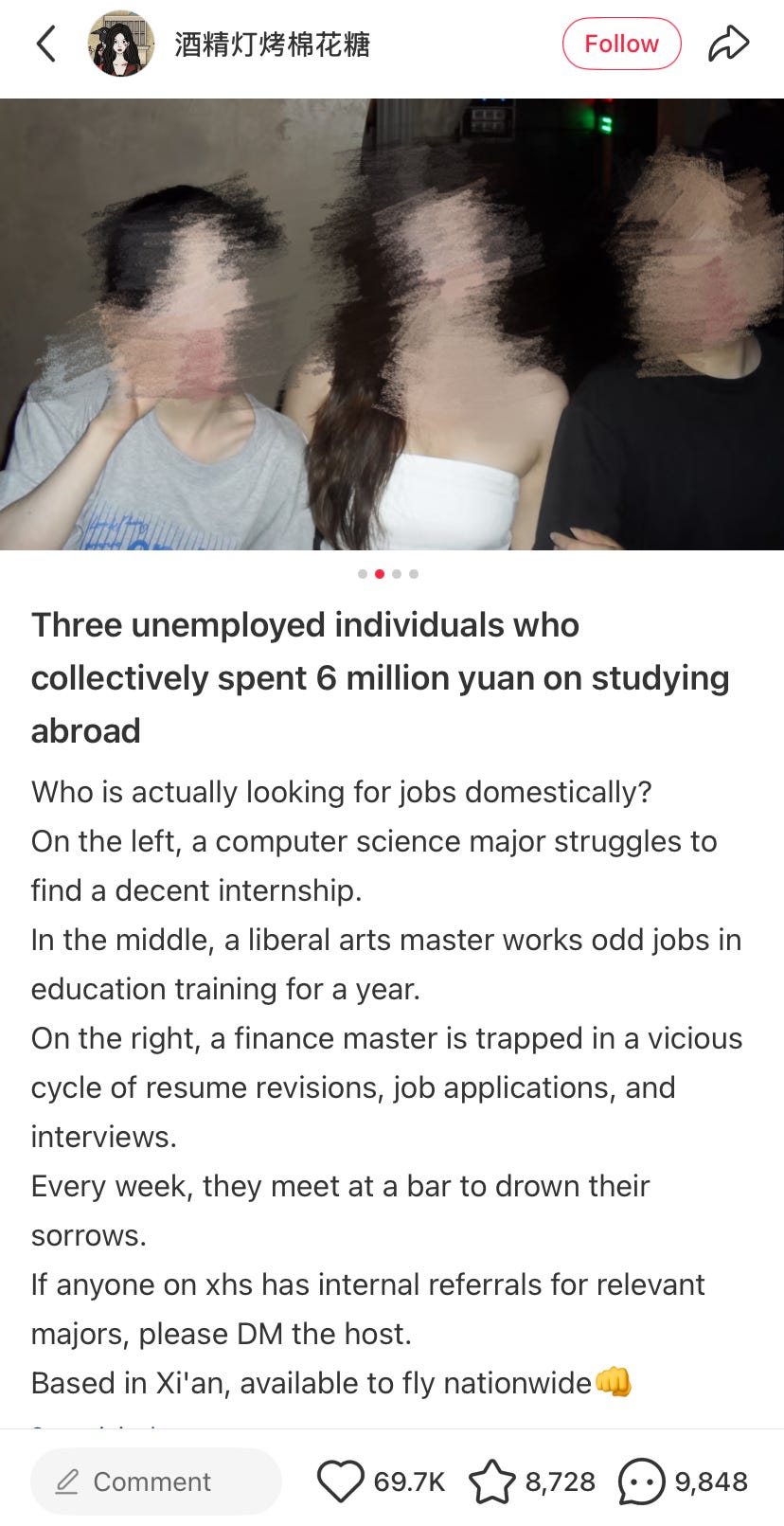
One observation that’s not showcased on social media but comes through my research and second-hand accounts is this:
Overseas education is inferior than domestic education in highly sensitive industries such as chipmaking and EV batteries, which are considered of national strategic importance.
In this context, Beijing is wary that these talents who cannot prove their political loyalty could be the targets of foreign governments, while the businesses are concerned about corporate espionage or key technology leaks. Typically, overseas graduates also tend to demand higher salaries, and are less likely to tolerate working overtime, which makes them far less desirable.
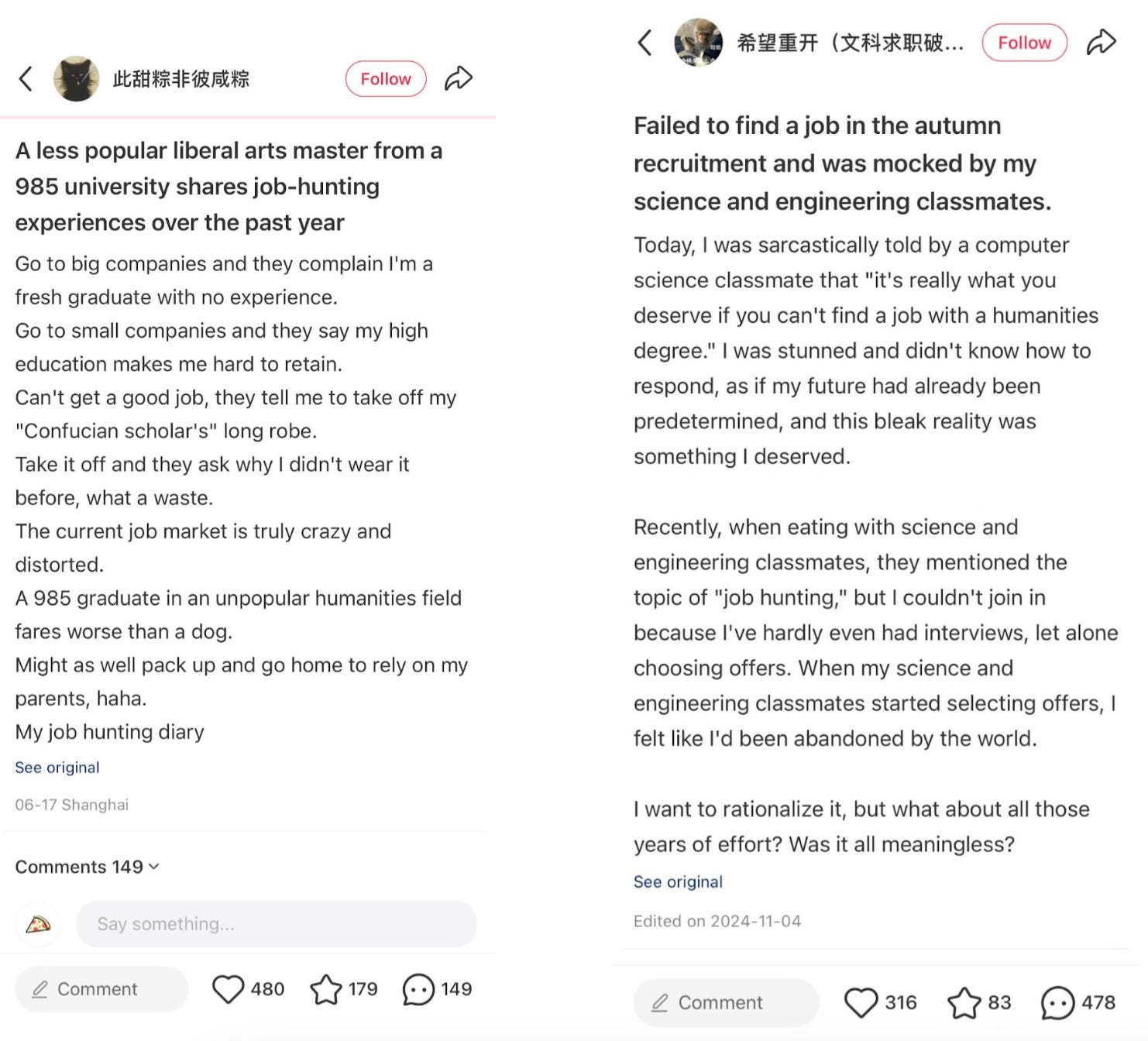
3. Things are extra hard for liberal arts majors
With a cultural narrative that often questions the “usefulness” of their degrees, and the larger AI wave that threatens their job availability and security, many liberal arts graduates find themselves at the sharp end of the job market squeeze.
4. STEM majors are used to their core
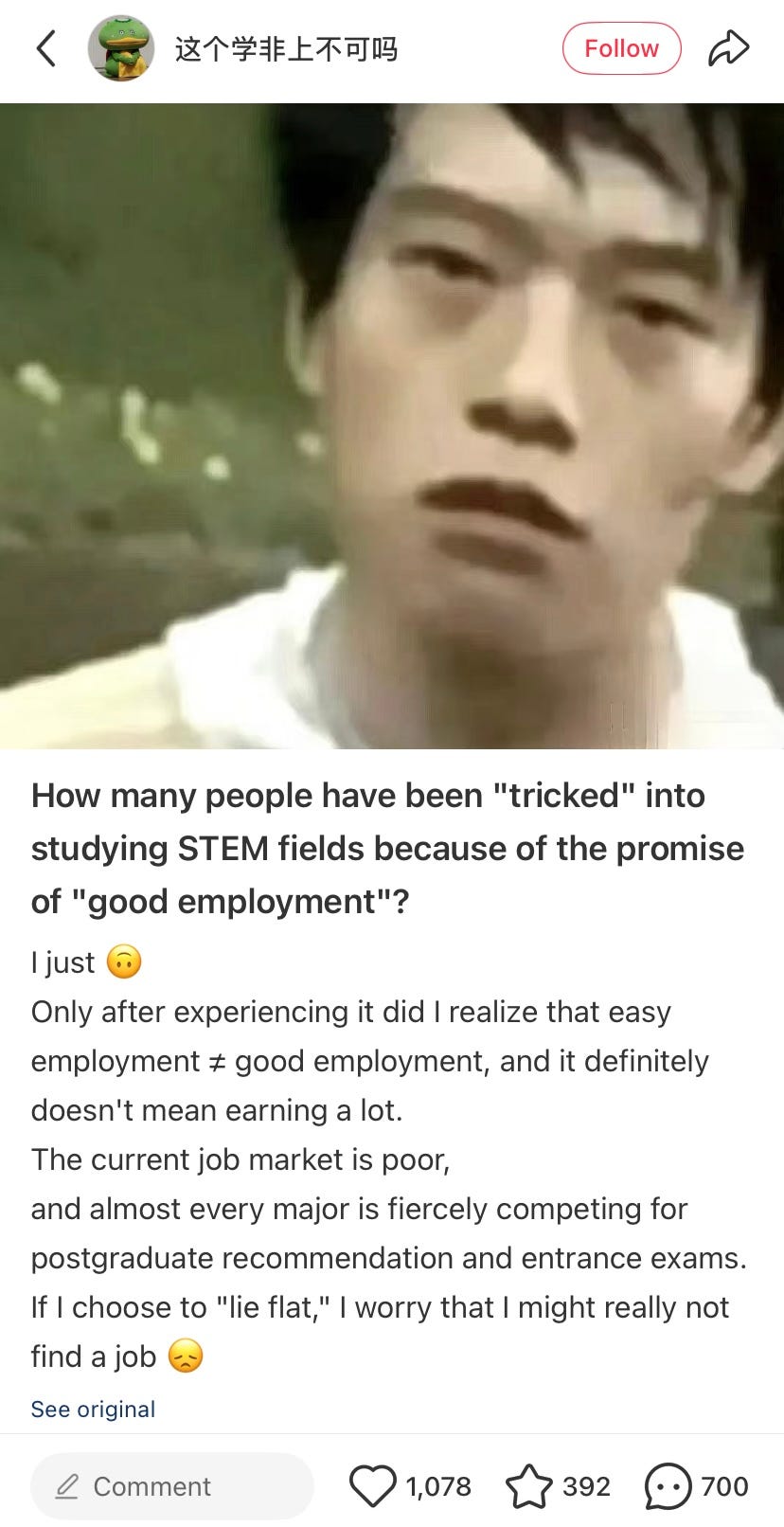
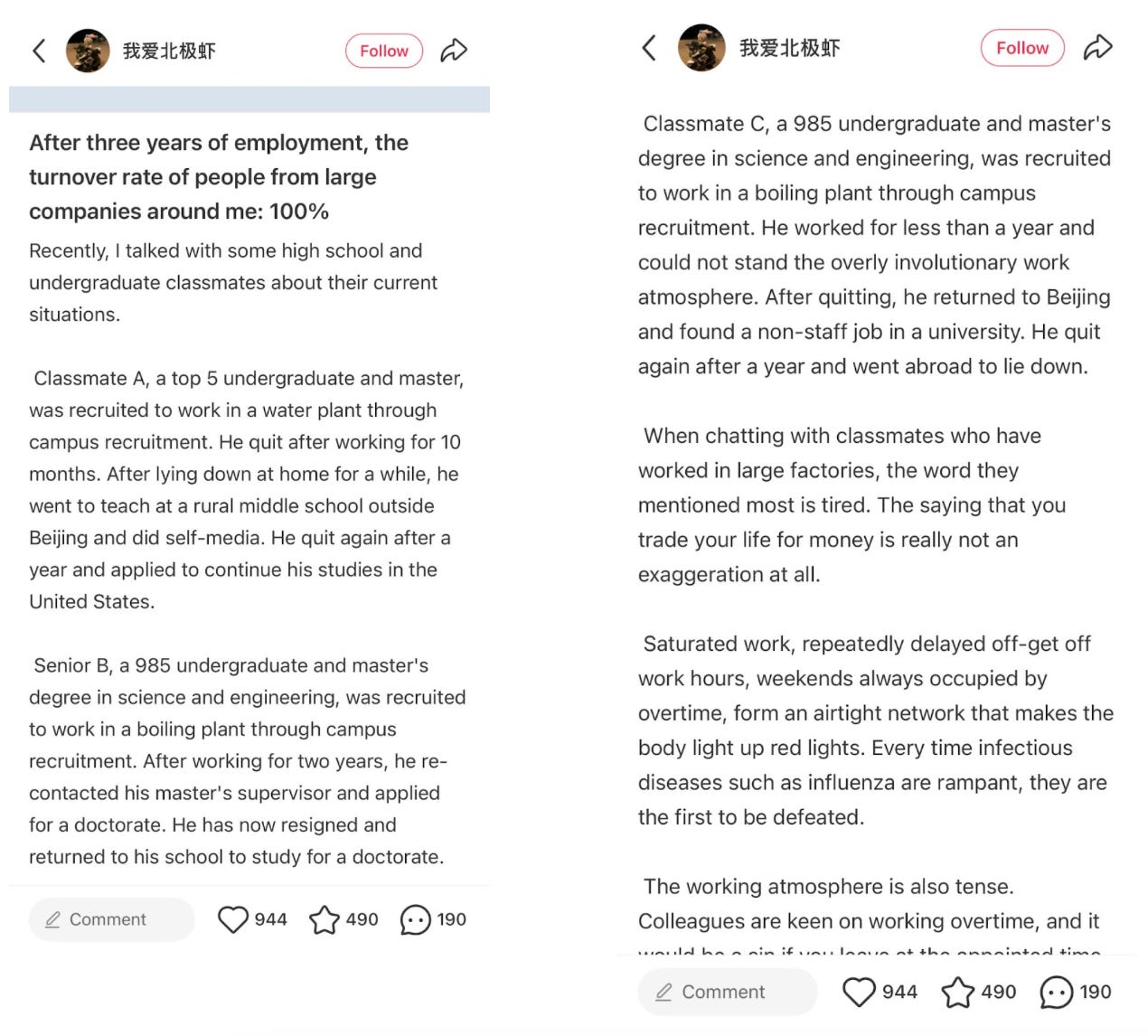
Around 10 years ago, STEM degrees were seen as a path to stable, high-paying jobs. But those who make it into the tech giants come to realize the true cost: Grueling hours, relentless pressure, and the sense of trading health for a paycheck. Moreover, they tend to find themselves “expire” around the age of 35.
Last words: I want to highlight these human accounts not because they are the only stories, or should define the entire narrative of China’s job market.
But because they are often overlooked, or deliberately ignored. 🔚
I find it interesting reading stories about overseas graduates struggling to find work back in China. From our company's perspective in Shanghai, we'd actually love to hire these people. The math is simple - having employees with good English, international experience, and solid work habits would boost our revenue significantly.
We've tried recruiting from this pool, offering good salaries and reasonable working conditions. Our expectations aren't crazy high, and we don't have the brutal hours you see elsewhere.
But honestly, the experience has been disappointing. We've had recent graduates who spend entire days doing essentially nothing, even when they could easily solve their problems by asking AI or doing basic research. Instead, they end up scrolling social media.
We eventually had to let them all go, though we keep trying. What's amazing is that our best performers are people without fancy degrees or big city backgrounds - folks who came to Shanghai hungry to work and learn. These guys literally get 3x the work done compared to college graduates with prestigious credentials. They're street smart, figure things out fast, and don't waste time. When they hit a problem, they solve it instead of sitting around. Their attitude and hustle beats fancy degrees all day long.
We haven't given up on finding overseas talent, but it's taught us that work ethic and street smarts beat credentials every time.
It’s a bit crazy to think that those with overseas degrees ended up returning to China. I suppose they didn’t know how bad the situation was at home, didn’t have luck finding work overseas and had no choice, or perhaps have parents whom they wanted to be close to. I know of one engineer who chose to return to China during COVID, and that was seen as a logical way by many.
And I think it’s almost common knowledge in China that studying humanities is going to make job hunting especially tough even during the best of times…
As I’ve been saying to anyone who would listen, people should leave while they can. In the best case scenario, things stagnate for the foreseeable future. If the economy and your livelihood plateaus while the rest of the world continues progressing upwards, then you’re slowly declining over time. Even worse for your kids if they come into the picture.