


How exactly is China’s AI computing power being used?
Beyond the huge sums companies spend on graphics cards to boost compute, newly built data centers also take up vast amounts of land and water resources. Given these costs, people naturally expect computing power to serve some worthy purpose, such as scientific research or improving ordinary people’s lives.
So when the hashtag “Over half of China’s AI compute is making shuangju” appeared on Weibo in mid-October, it quickly set off a public uproar. Mainstream media rushed to cover it, and the topic amassed nearly 1 million views on Weibo to date.
When Following the Yuan traced the data back to its origin and its path to virality, we found sloppy handling at every step: unclear source, careless citation by both company to investors, and the media that amplified it. And we believe episodes like this expose broader gaps in China’s media reporting and data disclosure.
Fear and Loathing in AI token Spending
Shuangju (爽剧), literally “cool-feeling dramas,” refers to short dramas (短剧) built on instant gratification. It carries a derogatory tone.

As of 2025, China’s short-drama market had reached 67.79 billion yuan, up 34.4% year-on-year, according to iiMedia Research. The research firm expects the market value to grow over 150 billion yuan in 2030.
As of September 2026, Hongguo, China’s largest short-drama app by users, had reached over 200 million daily active users, who spend an average of 165.98 minutes a day on it, QuestMobile reported. That average daily spent exceeds the combined time users spend on China’s top four streaming platforms: Mango TV, iQiyi, Tencent Video and Youku. In short, it has disrupted China’s online entertainment industry.
Since ByteDance released its video-generation model Seedance 2.0 this February, AI short drama as a sub-category has seen explosive growth. Compared with traditional short dramas, AI is able to cut the production cost from 200-300,000 yuan to under 10,000 yuan in some cases.
While the short-drama market booms, it has also faced accusations of “amusing ourselves to death” and “tittytainment” (奶头乐, pacifying the public with cheap entertainment). Critics say that users get a rush of gratification with absurd premise and high stakes, which erodes their attention span and cognitive capabilities.
So it is no surprise that when people heard “over half of China’s compute is making shuangju,” many Chinese users described it as “abuse.”
The eyebrow-raising claim originates from Shenzhen-listed company Chinese Online’s (中文在线, COL for short) investor relations activity record on June 3. Such records is similar to earnings call transcripts.
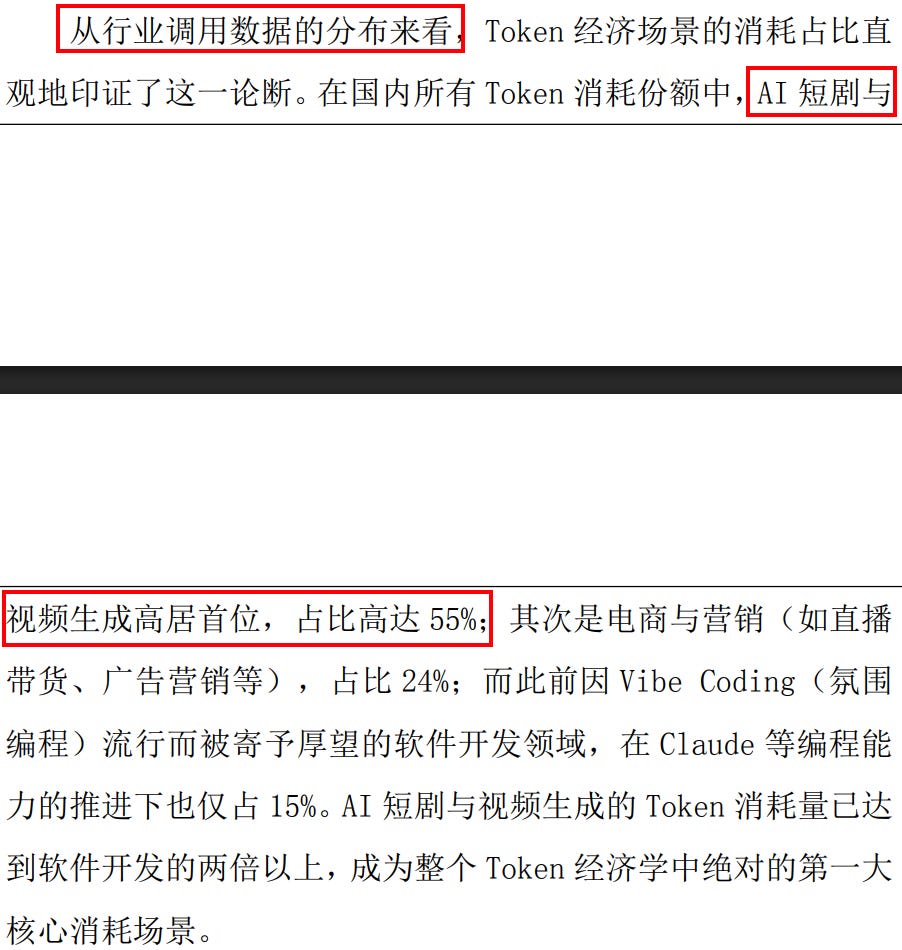
It reads: “Judging from the distribution of industry call data, AI short drama and video generation rank first among all token consumption in China, accounting for as much as 55%… the single largest core consumption scenario in the entire token economy.”
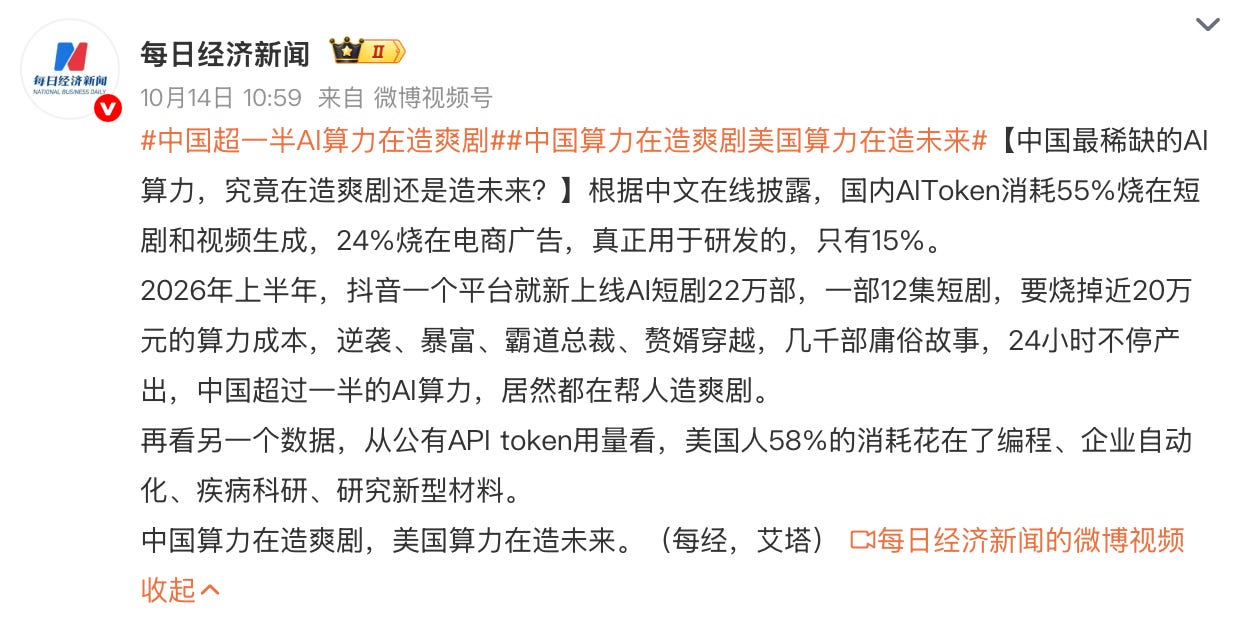
National Business Daily (每日经济新闻), which first created the relevant hashtags on Weibo on October 14, cited US public API token usage for comparison: 58% of American token consumption goes to programming, enterprise automation, disease research and the development of new materials.
“Chinese compute is making shuangju, while American compute is building the future,” it concludes in the social post.
NBD gained nearly one million views for the sensational hashtag. But it in fact further muddles the distinctions between AI compute, AI tokens and public API tokens in public perception.
The Big Long
Even more problematic is the data itself.
Such records are simply a company’s one-sided account for investors. This record also gives no source for the data.
What deserves a closer look is COL itself. Having been listed in Shenzhen in 2015, COL has its roots are in online literature and digital publishing, and has bet everything on AI short drama since 2024. In February 2026, it submitted a prospectus to the Hong Kong Stock Exchange, eight months later, it announced to , and it withdrew it in early October.

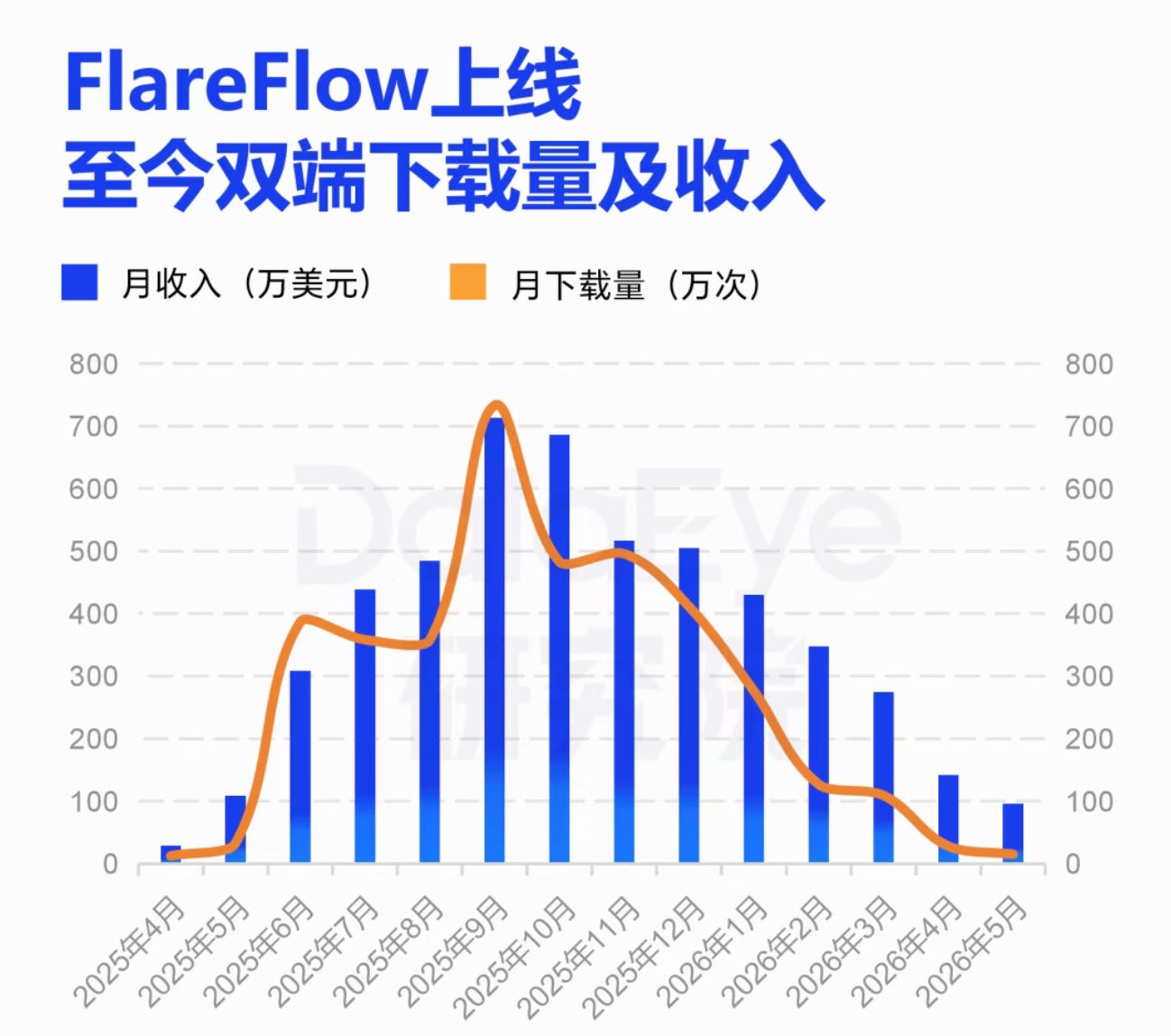
As self-claimed “overseas trailblazer of China’s short drama,” COL operates overseas short-drama app FlareFlow, which reached the top 5 of Google Play’s U.S. entertainment chart and the top 8 on Apple’s within weeks after launching in April 2025. It also owns a 49% stake in Crazy Maple Studio, which operates video streaming app ReelShort.
Shenzhen-based intelligence platform DataEye reported in June that both of FlareFlow’s downloads and monthly revenue had plummeted, falling from 7.13 million US dollars in September 2025 to 960k US dollars this May. In a later interview with DataEye’s media arm, FlareFlow CEO James Wang declared that it has been profitable since Q2 2026, without disclosing the specific numbers.
COL’s group financials are also bleak. Since going public in Shenzhen, the company accumulated losses of more than 3 billion yuan. In the first three quarters of this year, the company's revenue fell 17.64% year-on-year to 833 million yuan.
The picture is very clear. As a loss-making company that was seeking a HK listing, COL pinned its hopes on AI short drama as a turnaround story.
Besides the June 3 record, COL also published similar records on July 20 and July 29. Their wording was broadly similar, and all aimed to convey that “the AI short-drama market has limitless potential.”
For example: “China’s short-drama market is already close to 50 billion yuan and is expected to grow by more than 50% this year, while overseas paid short-drama platforms already have a total capacity of US$4 billion, growing at 100%.”
So why did only the ‘55% AI compute on short-drama’ get so widely distributed?
Chinese media’s role in amplifying this piece of unverified information has been overlooked.
Institutional investors may sneer at the seemingly exaggerated number and do their own research. Media outlets are supposed to do the same for public interest. However, they decide to take the numbers at face value and run with it, because they know it would grab eyeballs and they cannot risk having their competitors do it first.
In the aftermath, Liu Xing, Doubao’s head of PR, refuted the statement on Weibo, saying that the figure was unreliable: of ByteDance’s total compute, only 10% goes to training and running video-generation models. (Doubao and Hongguo are both apps under ByteDance.)
It’s interesting that one company’s boasting can hurt another company’s public image.
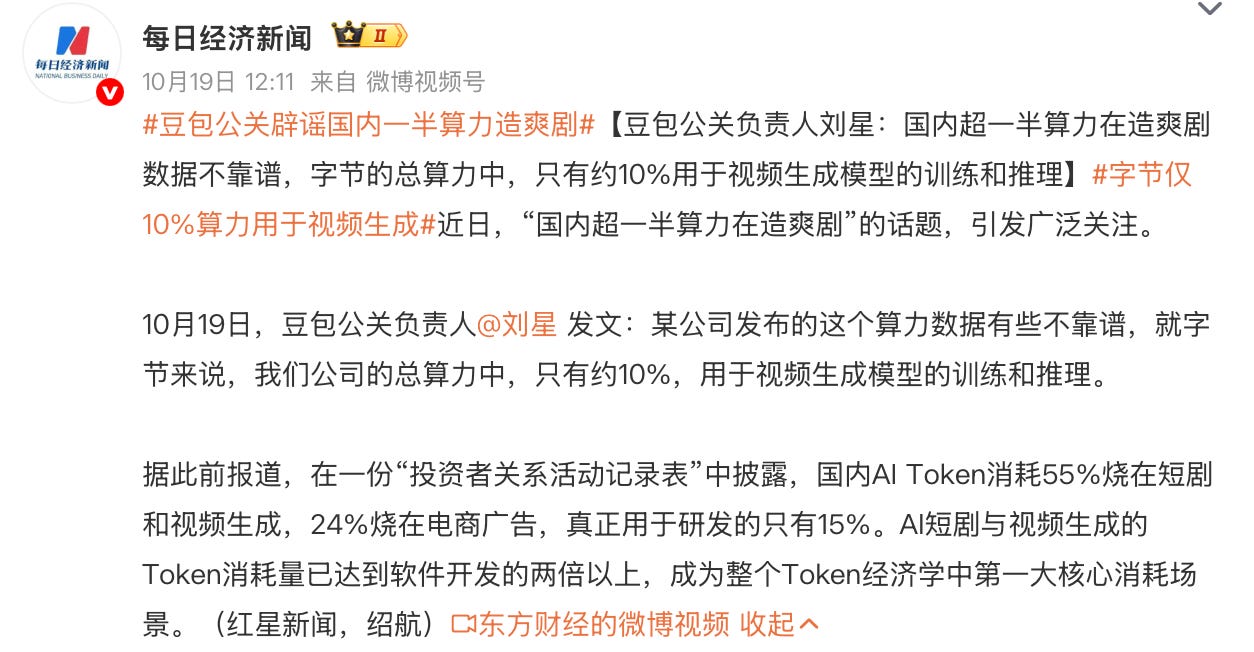
ByteDance can speak only for itself, so we still do not know how much compute in China is used for “making shuangju,” and how each Chinese AI company divides its compute among uses is known only to the company itself.
Without official disclosure and statistics, the industry can only guess at certain indicators to suit its own needs. How far does an AI company owe the public disclosure of its data? Does the public have a right to know how much energy an AI company actually spends on training, what its compute is used for, and where its training data comes from?
The creation and impact of misinformation are a common sight in China’s information system, which is ephemeral and attention-driven.
In a media environment that is highly commercial and censored, with users scattered their attention on different apps, short videos and short dramas, media feels the need to chase clicks just to survive.
When this meets with heightened self-interest of a struggling public company, it creates a recipe for disaster in covering AI, a major shift in human history. 🔚
We also recommend you read Zilan Qian’s piece on ChinaTalk, which deploys a more philosophical take:
