

Key takeaways:
Laopu Gold’s popularity is partially driven by the recent rise of gold price of 40% from a year ago, as well as a new, distinctly Chinese style of clienteling.
Chinese consumers are increasingly turning inward—seeking meaning, identity, and pride in their own heritage. This shift is creating ample room for brands in these price tiers.
Laopu Gold’s momentum has been questioned by both consumers and investors.
Long Er, a young professional from Changsha, recalled first seeing Laopu Gold on RedNote during COVID. She was hooked by its design and craftsmanship.
A sword-shaped pendant, meticulously crafted using traditional Chinese gold-casting techniques, stuck in her mind. She could not afford the 20,000-RMB price tag then, but it left a lasting impression. “Other brands’ gold jewelry often felt tacky, but Laopu’s designs are much more creative,” she said. She later went on to spend over 40,000 RMB at Laopu.
It was exactly the impression the brand founder, Xu Gaoming, a 61-year-old veterinary bureau staff-turned-jewelry-merchant, wanted to leave the potential customers with: jewelry is not just jewelry but carries identities and status. He wants Laopu Gold to be China’s Hermès.

As a fashion journalist and consultant, Laopu Gold (HKG: 6181) is a phenomenon I repeatedly talk about with peers and investors. Since its IPO in Hong Kong last June, its market cap has overtaken legacy titans like Chow Tai Fook (HKG: 1929). Its stores are lined with customers in a supposed economic downturn, it has been decorated with superlatives by Reuters (“a notable outlier”) and Forbes (“Hermès of Gold Jewelry”). It has over 30 stores in China and is looking to expand overseas.
For all the glowing headlines, one question still hums beneath the surface: Can it fill Hermès’ shoes and be China's real luxury, or fade like other Hermès of ice cream (Chicecream), Hermès of yoga (Fine Yoga), Hermès of milk tea (Nayuki), and even Hermès of braised duck necks (Zhou Hei Ya)?
What makes Laopu Gold sell?
Nelk Fang, a marketing professional from Nanjing, echoed Er’s sentiment but framed it through a pragmatic, investment lens. “A friend raved about their craftsmanship and how well it holds value,” he said. With international gold prices surging, Nelk saw Laopu as both an aesthetic and financial bet. He travelled to Hong Kong’s Tsim Sha Tsui to brave the store queues himself.
“The lines were crazy,” he laughed. “But the store locations were so prestigious — almost on par with major international luxury brands.” He wanted to purchase a pendant at a discount price of HK$ 12,000, but gave up his plan after a two-hour wait.
Since last June, Laopu's stock price rose from HK$ 70 to HK$ 800 at its peak this April, before coming down to HK$ 676 today, in the meantime, the gold price increased 27% US$2320 to $3170/oz. According to annual reports, Laopu boasts a gross profit margin of 41.9%, whereas Chow Tai Fook and Chow Sang Sang have margins below 30%, and Lao Feng Xiang around 9%.
From conversations with consumers like Long Er and Nelk, I found that the love for Laopu Gold isn’t necessarily rooted in the idea of “luxury” as traditionally defined - which emphasizes exclusivity, social hierarchy, and heritage craftsmanship.
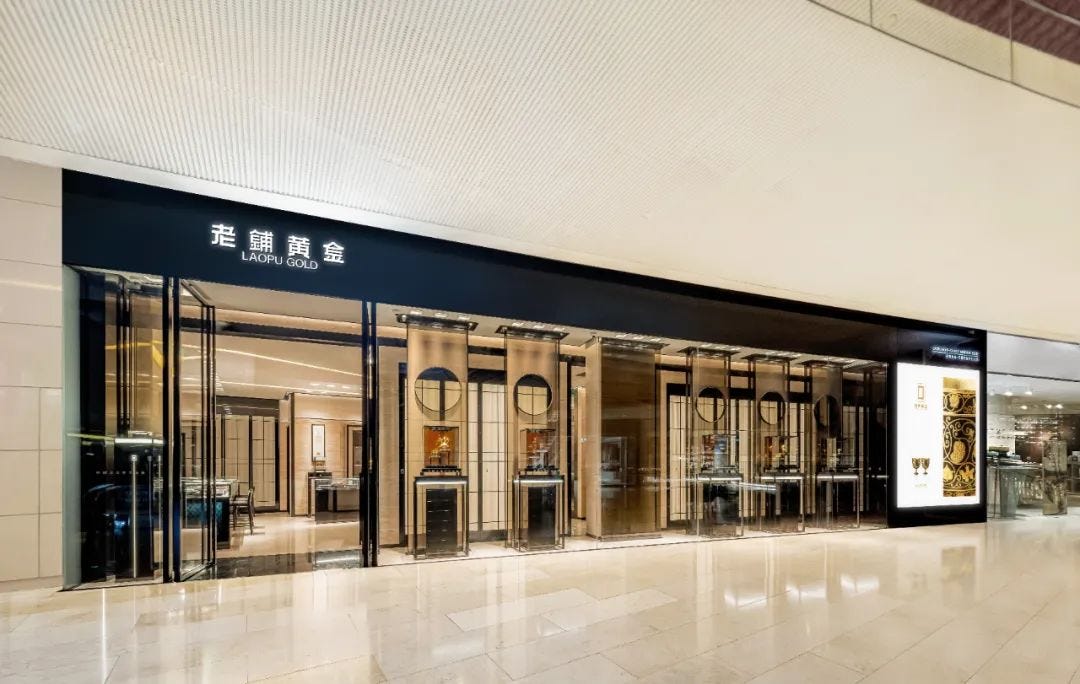
Instead, it stems from a heady cocktail of craftsmanship, cultural nostalgia, and the primal lure of gold itself — particularly as Chinese consumers are keen to acquire gold as a reliable investment asset. Compared to the ever-rising gold price, buying Laopu products feels like an investment.
However, the resemblance to Western luxury stops at the surface. Laopu Gold’s service strategy, interestingly, leans heavily into China's social fabric. Sales staff are chosen not just for looks, but also — oddly — for their ba zi (八字; a form of Chinese astrology, also known as the Four Pillars of Destiny, which maps people’s fate based on their birth date and time), emphasizing personal connection over aloofness.
Laopu Gold’s rise reflects something larger than itself: a subtle but significant shift in China’s consumer psyche.
As Western luxury’s mythology falters under the weight of geopolitical tensions and cultural fatigue, Chinese consumers are increasingly turning inward — seeking meaning, identity, and pride in their own heritage.
The pandemic accelerated this inward gaze. Suddenly, the old equations no longer hold. As we see not just in jewelry but other consumer sectors, Western didn’t automatically mean “better.” Local didn’t automatically mean “lesser.”
The search for Chinese luxury
In the excitement of Laopu Gold’s ascent, many dared to hope: Could this be it? The first wholly Chinese luxury house — indigenous, proud, and global?
History offers precedents that feel both inspiring and cautionary. From Qeelin, founded by a Chinese entrepreneur but eventually bought by Kering, to the brainchild of Jiang Qiong'er and Hermès, Shang Xia, both of which were largely conceived through the Western gaze.


Laopu Gold, by contrast, feels deeply local — it is a brand born on Chinese soil, out of Chinese craft and Chinese aspiration.
But I want to be the bad guy to break the myth - Laopu Gold may never be a true luxury brand in the traditional concept. None of the consumers I talked to admitted that Laopu Gold is a luxury brand.
First, the notion of luxury was invented by Western brands. Interestingly, Changsha-native Fang Xing said that Laopu Gold is a replacement for luxury jewelry like Cartier. In her mind, she would equate luxury to the likes of Louis Vuitton or Hermes, she told me.
Iris Chow, a Hong Kong-based professional and customer of Van Cleef & Arpels, Chanel, and Dior, said she wouldn’t consider buying Laopu Gold unless it was on discount. "Since last year, Laopu Gold has raised prices several times, and the lines are getting longer,” she said. “I don't like this and I won't purchase it again.”
Having spend over 20,000 RMB at Laopu, she currently has her eyes on another local jewelry brand Jemper, which also deploys traditional Chinese goldsmithing techniques. Before following the industry trend set by Laopu, Jemper initially focused on selling jadeite and colored gemstones since founding in 2014.


From storefront to service, Laopu Gold crafts the illusion of luxury. But the brand's promotional tactics — heavy use of discounts, social media amplification, and tacit Daigou endorsement — reveal its true strategy and outcome: mass aspiration, not exclusivity.
As Nelk Fang put it bluntly, “Right now, there’s a gold rush — yes. But it feels like a trend. It could fade.”
The man behind the scene
Laopu Gold didn’t stumble into success. It engineered it.
The brand combined a playbook almost laboratory-perfect:
First, enlist celebrities like Yang Mi and Sun Qian to showcase the designs, igniting the first wave of curiosity.
Second, starve supply: open limited stores in elite locations, creating queues and a visual spectacle of scarcity. (It’s offline retail strategy — opening stores exclusively in high-end malls — has been copied by late comers like Jemper.)
Third, turn a blind eye to Daigou activity — allowing resellers to amplify the narrative of "hard to get" without tarnishing the brand's hands. Finally, mirror luxury service norms: VIP salons, one-of-a-kind style, 1 to 1 company.
Xu Gaoming, Laopu Gold's unlikely founder, grew up far from any jewelry atelier.
Xu joined the wave of going into the private sector as a former staff member of the veterinary bureau in Yueyang, a third-tier city in Hunan province. He once dealt in the cultural tourism industry, collecting artifacts. In his past lives, two lessons crystallized: that true collectors crave rarity above all else, and that China was birthing a new generation — hungry for identity, status, and symbols of permanence.
He had the audacity to position Laopu Gold among high-end giants from the outset, installing the brand beside Western luxury houses in China’s elite malls — Beijing SKP among them.
The rise of Laopu Gold should teach an important lesson for the Western counterparts - understanding local culture in real-time is key.
The China of the 2020s is not the China of the early 2010s; that landscape has shifted. Brands like Laopu Gold, for all their rough edges, signal a maturing market where cultural resonance, craftsmanship, and national pride can eclipse mere imported glamour.
More crucially, Chinese consumers themselves are questioning the very notion of luxury. In this new era, prestige will not be given. It will have to be earned — again and again.
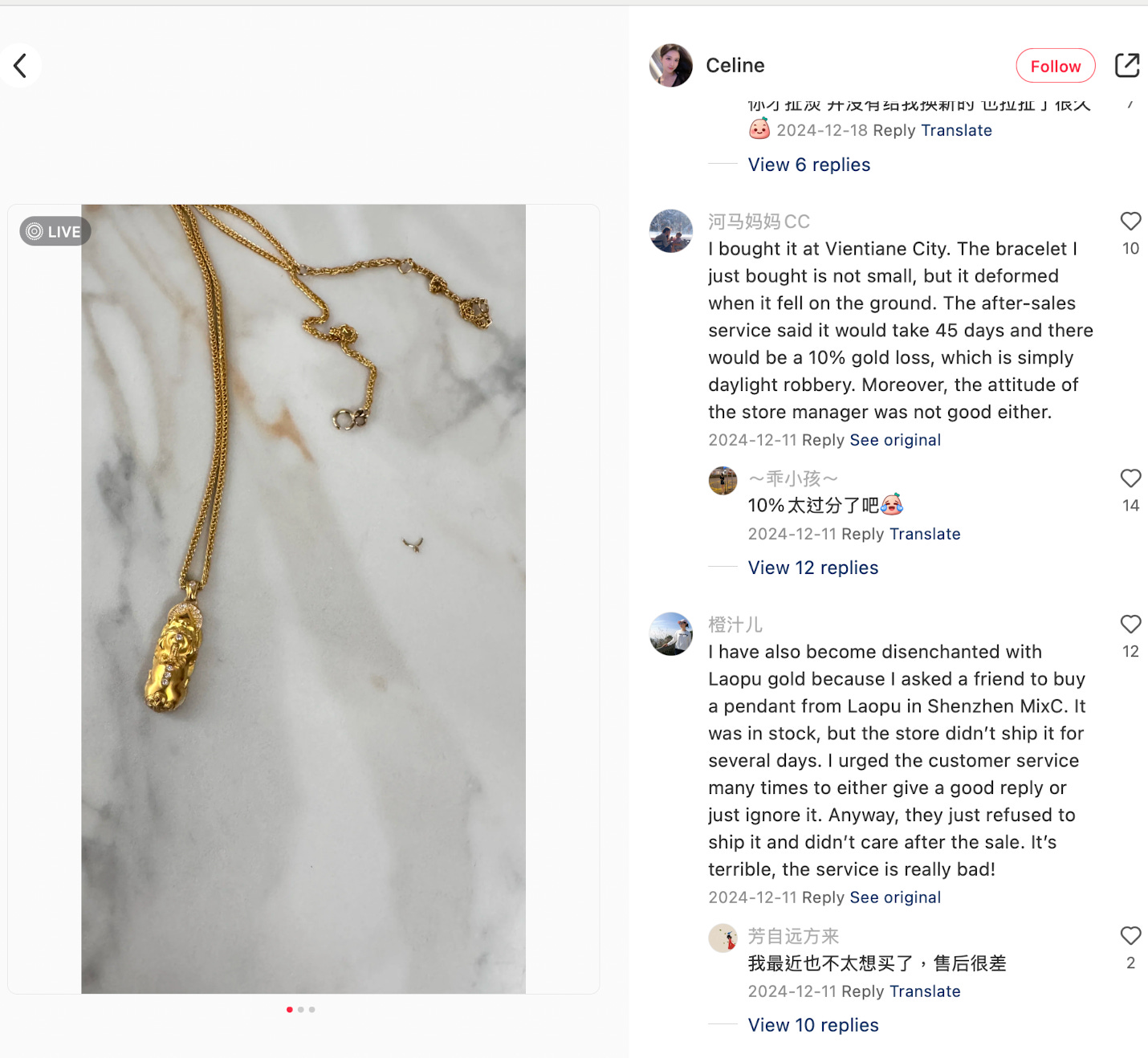
Laopu Gold may not be the final answer to Chinese luxury. As of recent months, more complaints about its quality and after-sale services have surfaced; its stock price fell. But it has, unmistakably, moved the conversation forward.
Editor: Yaling Jiang
(Header image: screenshot of Laopu’s official promo video)
About us: Following the Yuan is a reader-supported publication that aims to deliver real-time insights about Chinese consumers from native Chinese experts. We are looking to change our offerings in the coming months, subscribe now to lock in the price.
Ignoring comparisons with western luxury brands like Hermes would be a good step towards becoming a global luxury brand I think
Great article, but in my dismissive take on "luxury", I think it misses an important point. China has a multitude of craft schools turning out absolutely amazing works of "art" in the form of jewelry/clothing/handbags/whatever that are easily the equal of any over hyped commercialized craft/art. This isn't to take away from Laopu Gold, but it's a much bigger world that Laopu Gold, and to anoint one brand as the pinnacle is missing the forest for a tree. Liu Shanlin in Shiyan, Hubei teaches at the Craft School (I forget the full name) and he is turning out a generation of brilliant crafts artists creating the next wave of "luxury" goods.
Point being, less "luxury" and more appreciation for all those China artists working right now. Find them, pay them money for their work, and the tradition lives. Get too involved with "luxury", and the traditions die. Keep it alive!