Hi it’s Yaling,
I really didn’t think I would be the perfect ambassador for the Chinese voice-to-text app, Typeless, until this week.
As some of you might have seen on Substack Notes — my left collarbone is broken and my left hand is in a sling, which limits my ability to do any chores or type on a laptop.
Thankfully, Typeless is helping me transcribe and format the messages I want to say and the emails I want to write back. I was already a free user before my injury, and the day after it happened, I paid for the £150/year subscription without hesitation. (Here’s a referral link in case you want to try it 🫣)
But Chinese AI products are not just limit to what people can use on their devices. Along with part 2, this guide walks through three categories — smart wearables, home products, entertainment & companionship — many of them shown at the recently concluded WAIC in Shanghai that was addressed by President Xi Jinping, and on mainstream e-commerce platforms. (You can read more about WAIC from AI Proem’s coverage, written by our friends Grace Shao and Rachel Zheng.)
I do not have immediate access to these products as I’m currently back in the UK, however, under each description, I will give you a few simple reasons why I want to try them or not.
Imagine a life where you’re wearing glasses that translate for you, a pendant that notices when your mood dips, exoskeletons that carry you further, lamps that tutor your kid… and now let’s jump in.
01 Smart Wearables
🕶️AI Glasses
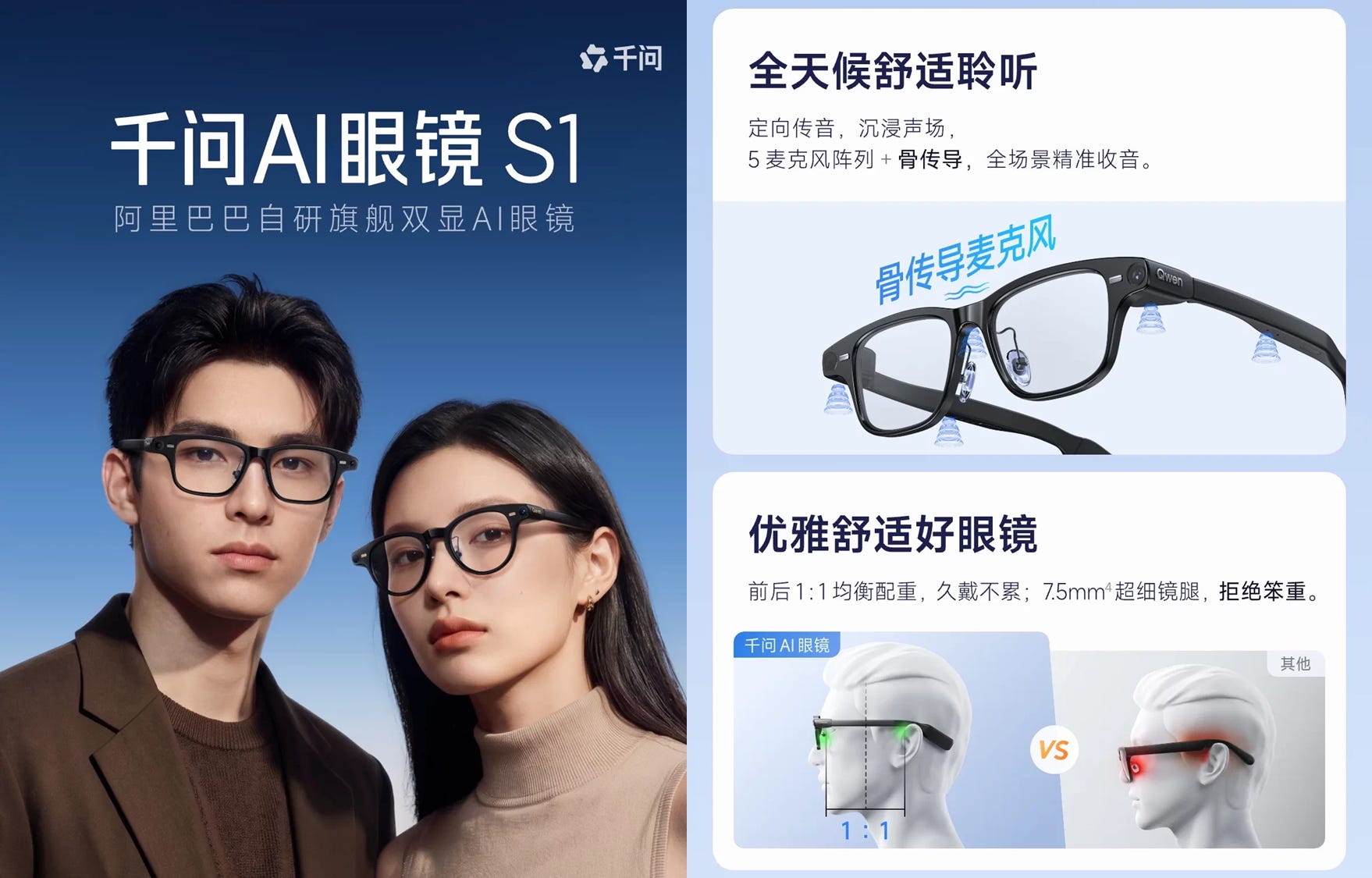
Alibaba Qwen AI Glasses
Qwen AI Glasses are AI hardware terminals launched by Alibaba based on its Tongyi Qwen large language model, featuring series such as the S1 (equipped with a binocular display) and the G1 (focused on audio and photography). It offers features including real-time object recognition, simultaneous translation, first-person navigation, and voice meeting transcription.
Price: S1 ¥3,499; G1 ¥1,869
Yaling’s verdict: As a contacts-over-glasses person, AI glasses never appealed to me.
I also don’t think they’re headed for mass adoption in China. Aside from the privacy concerns well-discussed in the West, here are two recent policies/events that add to the hurdles: On June 2, the Ministry of Education issued a clear warning ahead of the national entry exam: regardless of the reason, and regardless of whether it is actually used, bringing a mobile phone, smartwatch/smart band, smart glasses, or similar device into the exam hall constitutes cheating.
Outside the exam hall, AI glasses have also sparked social and ethical controversy. The Rokid glasses community was reported for a user uploading secretly filmed content of a flight attendant, triggering intense public backlash.