

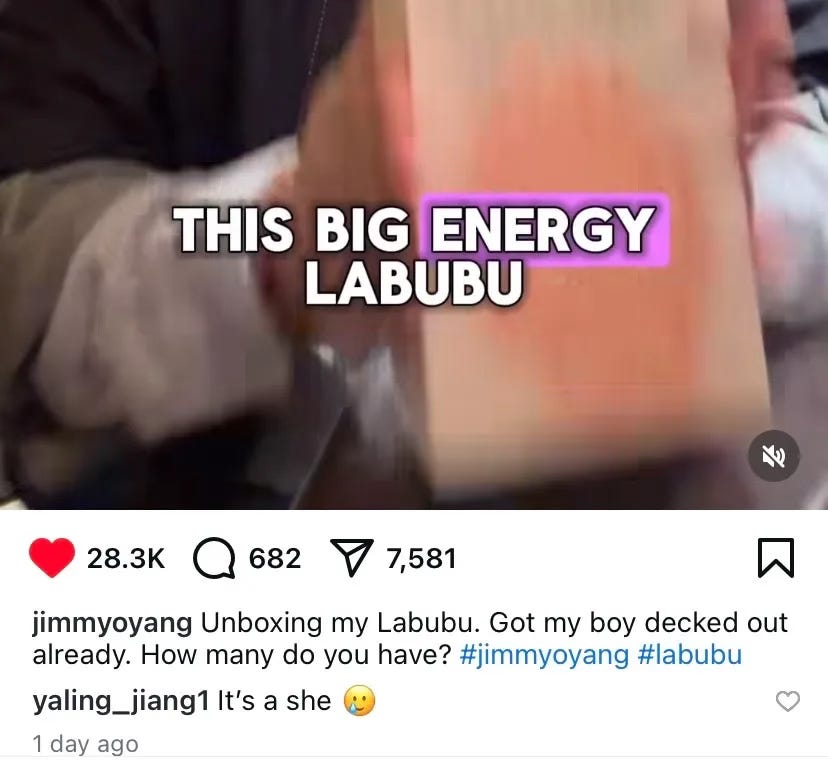
Last week, I wrote about Labubu’s ambiguous racial and gender identity, and now I find myself constantly wanting to start a conversation with “Did you know that Labubu is a girl?!” OR correct people, including Hong Kong-American comedian Jimmy O Yang, if they assumed she was a “boy.”
Bear with me, this week’s post is full of information sorting (imagine me on an assembly line). Please comment/share your thoughts so that I feel less lonely in my obsession.
Labubu's comet tail in China 🌠
Now that we are in the mass adoption stage of the Labubu trend, we are witnessing a large number of spin-off phenomena inspired by its popularity. These stories are like gas and dust trailing a comet, controlled by the magnetic fields of Labubu.
I’ve sorted some recent examples from news and social media into four main categories:
Celebrity x Labubu crossovers
Audience: mass audience, celebrity fans
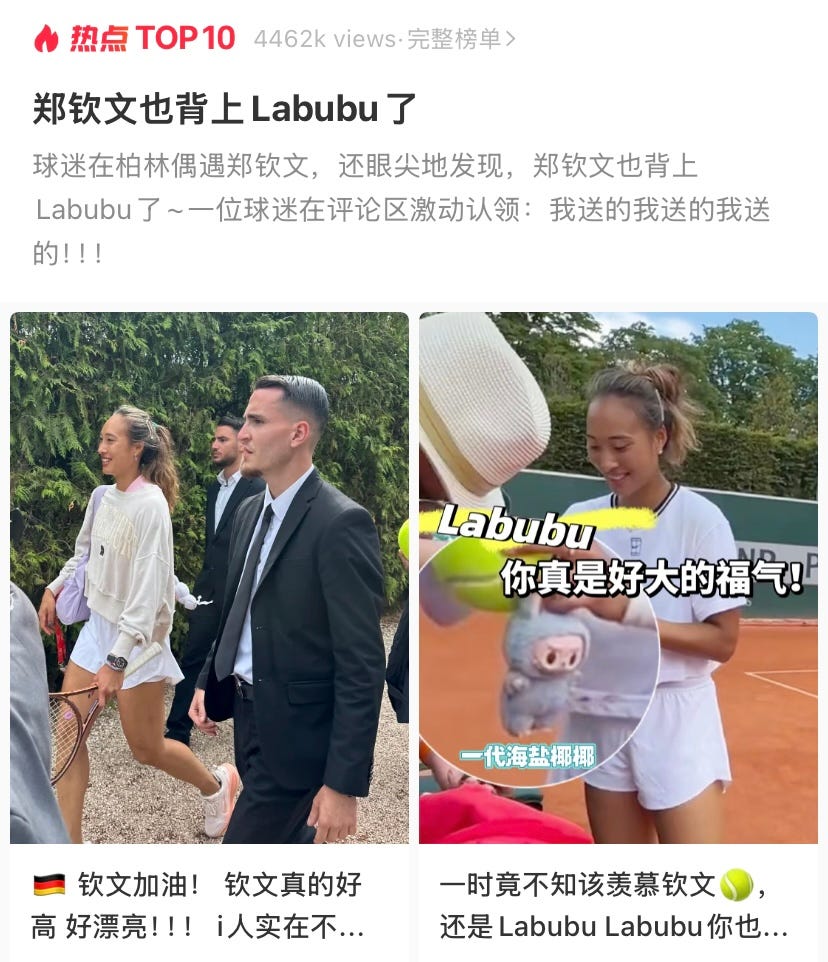
So and so celebrities doing unboxing of Labubu, being spotted with Labubu on their handbags. For example, Chinese producer and media personality Yang Tianzhen’s unboxing video, and Olympic champion Zheng Qinwen (below) being seen with a Labubu.
The Labubu lifestyle
Audience: owners of Labubu and other plush toys
“#taking Labubu on a day out” on Weibo: A couple took Labubu out on their date, buckling her up in the car, dressing her up in McDonalds uniform and buying her a happy meal
“#crowning Labubu” on Weibo: A woman not only handcrafted a phoenix crown for Labubu but also held a coronation ceremony.
Business opportunities
Audience: manufacturers, re-sellers and collectors
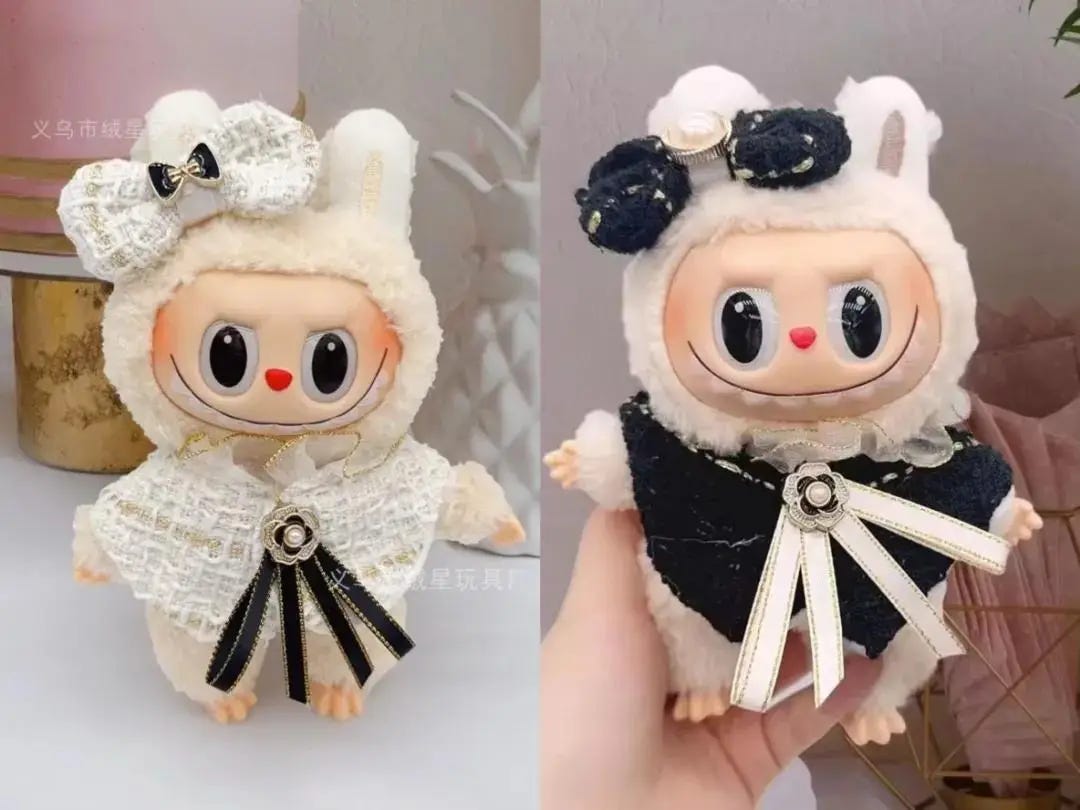
A Yiwu woman is reportedly selling 30,000 doll outfits for Labubu a day.
Re-sellers are bulk-buying a new series on vending machines and using illicit softwares to place online orders.
Gray market exposés
Audience: actually, same as above
Customs officers at Wuhan Tianhe Airport recently discovered 144 Labubu from passengers who intended to resell the figurines in China.
Separately, Ningbo Customs seized over 20,000 counterfeit Labubu toys. It is unclear whether the goods are exports.


Why is Starbucks China always late?🧋
Since Baiguan and I started writing about how Starbucks China wasn’t doing well back in 2023, the news has finally caught up. Here’s an excerpt from our April 2023 piece outlining where Starbucks was falling short—points that I still believe hold true today:
1. Fail to meet Chinese consumers’ changing perception about product price.
2. Fail to create new experiences and capture the cultural zeitgeist.
3. Fail to innovate on the product level at China speed.
In Nov. 2024, I followed up and wrote how the biggest mistake is that the HQ perceives ‘premium’ differently than Chinese consumers. I argue that the misunderstanding affects all the downstream decisions — pricing, product R&D, marketing, and competition strategy. The HQ’s self-perception felt Americentric, and out of sync with China’s benchmark of ‘premium’.
All of the above, and more, had been validated as Starbucks was said last November to think about selling its China stake, and it started the process this May.
Here, I want to further elaborate on some recent communications changes made by Starbucks China in 2025, how they are playing catch-up, and why. I hope it serves a constructive purpose for anyone making strategic decisions in China: you should always look beyond your direct competitors and immediate category, and communicate those shifts to your audience before it’s too late.
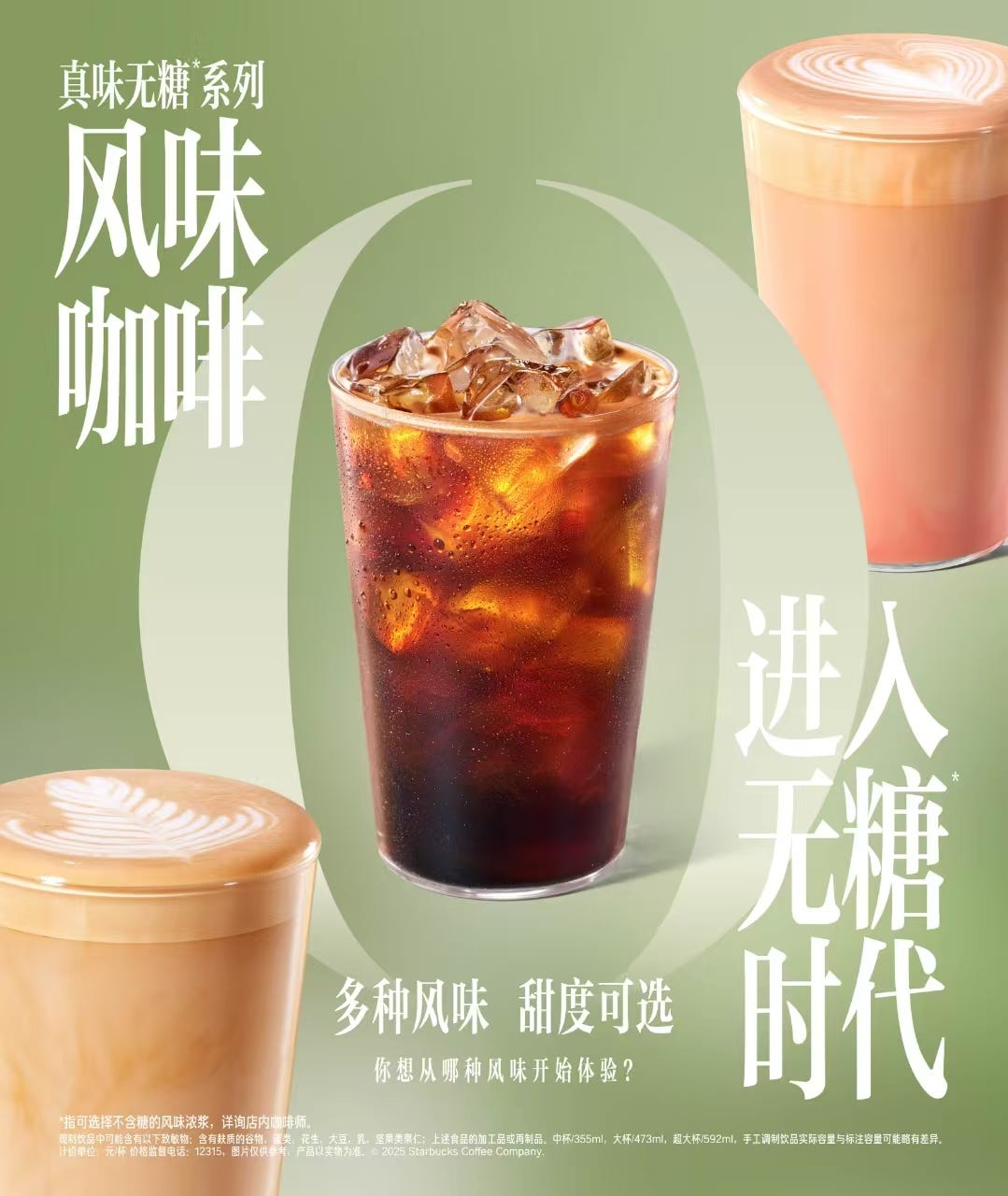
‘No sugar era’ (April 2025) —7 years late
Why: This initiative was introduced in early April in response to China’s new nationwide weight-loss campaign, which will run for three years. We’ve already seen several other multinationals launch similar initiatives, particularly on the corporate communications level with existing product lines.
It makes sense for Starbucks to jump in now, reiterating that customers can choose different levels of sugar. However, in China’s food and beverage world, the zero-sugar trend started several years ago with ready-to-drink beverages. Domestic brands like Nongfu Springs launched products inspired by Japan’s no-sugar tea in early 2010s, but the category didn't go mainstream until 2017/2018, as mass consumers’ awareness in sugar intake spiked. Being sugar conscious has already seeped into everyday consumer’s mind, hence the common orders of 30% sugar, 70% sugar, full sugar, in ordering freshly made beverages.
Discount, promoting ‘non-coffee’ category (June 2025) — at least 2 years late
Starbucks had been awkward about joining the discounting trend ever since post-Covid. Its founder and former CEO Howard Schultz famously said in early 2024, that it wasn’t joining in with local affordable brands’ steep discounting. While they quietly rolled out some promotions through delivery platforms and their app, the brand is still perceived as a 30 RMB-per-drink affair — twice the price of its local rivals in major Chinese cities.
Again, I think is due to its misplaced perception of ‘premium.’ Its rival Luckin has been offering so much more than just affordable coffee, moreover, Starbucks is also with China’s booming beverage market with players like Chagee and Mixue. Premium milk tea brand HeyTea’s 2022 across-the-board price adjustment—from 30+ RMB down to 20 or below—should have been a major signal to international brands. That was HeyTea’s preemptive move responding to the looming economic slowdown and downbeat consumer sentiment.
By the way, Starbucks remains one of my favorite topics to explore. If you are a current or former employee who would like to comment on this question “Why is Starbucks China always late?” or would like to challenge my assumptions and theories, please reply to the email directly or DM me!
Outdoor aesthetics in food & beverage 🏞️
As early as 2022, RedNote’s “Top 10 Lifestyle Trends of 2022” highlighted the concept of “mountain-style living.” This was based on a fivefold year-on-year increase in posts about camping and stand-up paddleboarding in 2021, and a sixfold increase in posts about frisbee.
2022 was also the final year of China’s zero-Covid policy. With Omicron-related lockdowns becoming increasingly unpredictable across China, many young consumers retreated to nature for inner peace.
The trend was initially rooted in sports and fitness. Overtime, business applications started emerging in other sectors, especially in food and beverage, to help value-driven consumers justify the premium. Branding and interior design of these establishments share a similar pattern: playing on the Chinese character “山” with variations of low-fi greens, earthy tones, and interiors filled with lush green plants.
Riding the wave of China’s tea and coffee boom, beverage brands like Saanci (est. 2021 in Shenzhen) Quchashan (est. 2000 in Guiyang) cleverly used lesser known regional ingredients to incorporate into their menus.


Recently, domestic media including Interesting Report noted that there’s an emergence of “mountain-style” hotspots with similar aesthetics entering the public eye. In terms of ingredients, “mountain-style” hotpot features uncommon wild vegetables, mushrooms and eco-sourced ingredients.
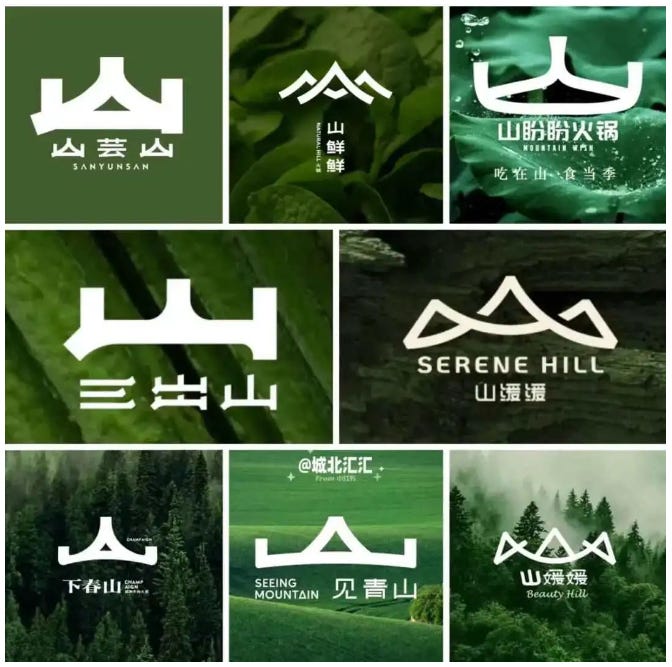
Whether it’s coffee, milk tea, or hotpot, the “mountain-style” outdoor aesthetic has become a proxy for an aspirational lifestyle. These business applications really underscore the value of observing China trends in the long term. 🔚
About us: Following the Yuan is a reader-supported publication that aims to deliver real-time insights about Chinese consumers from native Chinese experts and writers.
Within the last two weeks A LOT of the Starbucks I used to frequent have shut down. Best example this morning in Hongqiao Railway Station. And that one used to be pretty well frequented. Better get rid of my gift cards quickly.
The outdoor aesthetics in food & beverage -- YES, I noticed that so much recently. Even got attracted to buy a tea from Like No Other because they had this matcha tea that looked like a green forest mountain ⛰️ .. honestly didn't turn out to be to my liking, but you gotta try these things sometimes.