

Hi everyone, hope your days are getting brighter as they are in London (physically and metaphorically). Thanks to those who attended last week’s ‘On the Ground’ session at LSE, where we did the highly anticipated book raffle and discussed many recent topics like Ne Zha’s global box office, what’s holding back Chinese companies’ overseas expansion, and whether Rednote’s hype is sustainable.


As of today, the made-in-China animated movie’s global box office already reached 14 billion RMB. While the initial buzz may have more to do with the content itself, a new factor in the latter phase of the rise in numbers has been nationalistic spending by companies and individuals who bought group tickets to fuel the momentum. A stark contrast is that Captain America: Brave New World only amassed a little over 100M RMB in China so far, which I think needs to be analyzed along with its poor screening rate (排片率) of 1.6% versus Ne Zha’s 55.1%, according to Maoyan Pro.


[Sorry there’s something wrong with the caption feature today — the above are some live trackers on Rednote of Ne Zha’s global box office]
A Rednote user quipped: “We seem to be able to achieve anything with our concerted efforts, why can’t we use this energy to make everyone work 4 days a week?” Below, a highly rated read: “Because if we dare to do the latter, the system would work us instead.”
The deaths of ‘premium’ in China 💀
After seeing things evolve in tandem and picking them apart separately: stores closing in prime locations, the seemingly never-ending bankruptcy of VC-backed Chinese consumer brands, and the decisive exit of overseas brands. I realized that all of this shares an underlying commonality: Unwanted premium by Chinese consumers.
Take the last category for example, the much-talked-about names are Inditex group’s Oysho and YNAP’s Net-a-Porter — does the fast-casual brand and the luxury e-commerce platform have anything in common? Yes, if you can’t prove your worth in terms of value, product, marketing or experience, then you’re out of consumers’ minds.
The discrepancy in price points between Oysho and white-label athleisure on e-commerce; and the discrepancy in experiences between buying luxury on mobile platforms (through a third party) and offline, are both unwanted. So why would consumers pay for this?
In the ultra-competitive coffee sector, SeeSaw, which had 160 stores in 2022, is another recent example in the second category. Staff in many first-tier city stores over the last few days told media that they haven’t been paid salary in months, the founder Wu Xiaomei has been restricted from high spending (a punitive measure in China’s Civil Law).
That is not to say that ‘premium’ brands don’t sell — look at Prada Group’s Miu Miu and Amer Sports (Arc'teryx, Salomon, Wilson, Atomic, and Peak Performance)’s recent performances, which Chinese consumers still find worthy.
KFC VS McDonald’s fried-chicken war 🐔
As trade wars and tech wars continue to unfold, another type of business war emerged has emerged in the last few weeks in China: a fried-chicken war between KFC and McDonald’s.
McDonald's launched the "CFC (Cage-Free Chicken)" campaign earlier this month, which aims to promote its own high-quality chicken under the slogan "Cage-Free, Better Chicken." The campaign design features a red-and-white slanted text poster, resembling KFC's branding. McDonald's even placed billboards near KFC locations for a direct showdown.
Perhaps due to the fact that is indisputable, KFC did not respond to the cage-free part of the message but responded with a campaign called "Good fried chicken has flakes (好炸鸡有鳞片),” featuring a longtime staff from Jiangxi province, trying to shift the attention from their chicken to tastiness and…hmm craftsmanship?
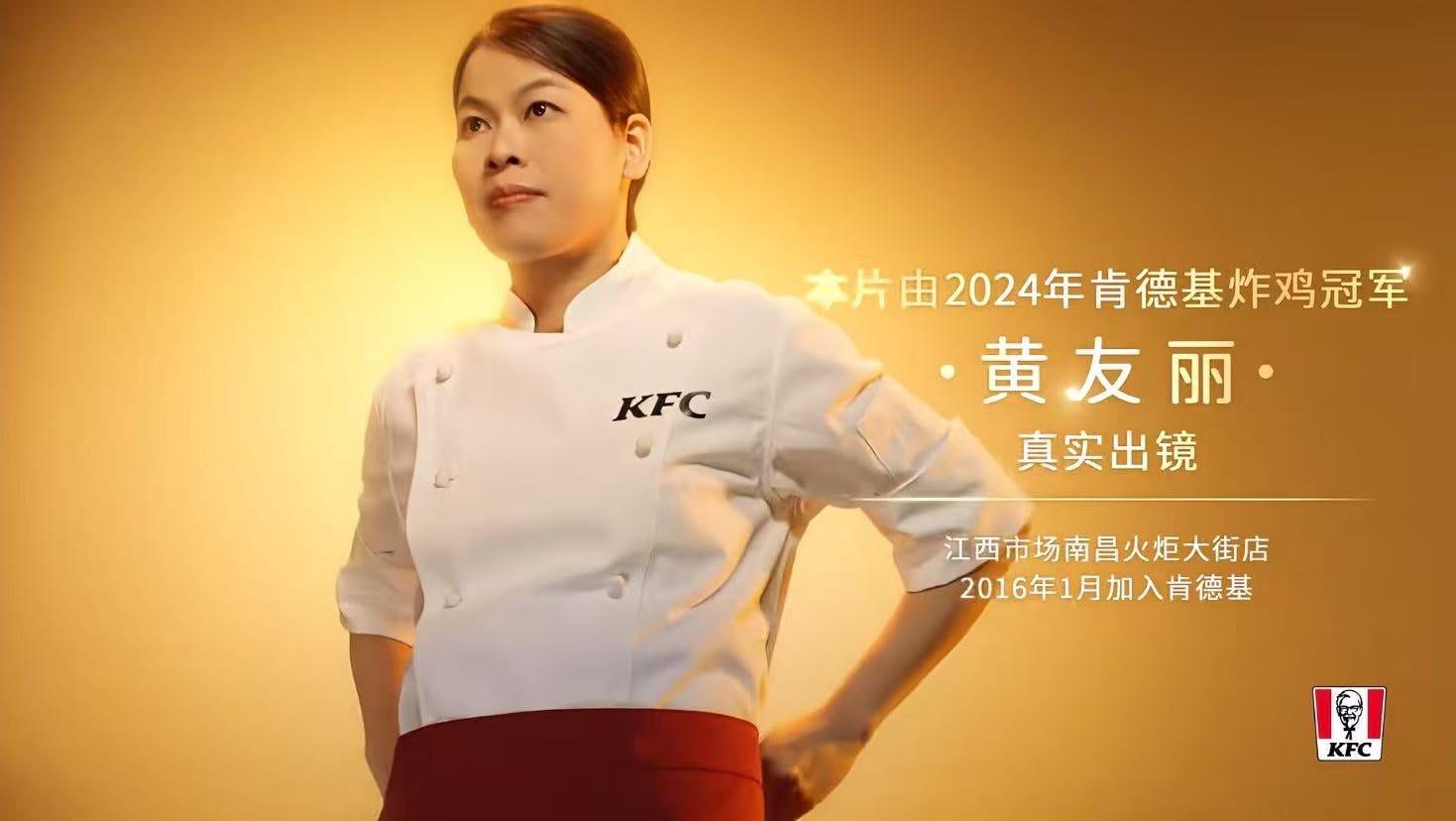
When it comes to products, KFC even sent advertising trucks to McDonald's locations and launched a "29.9 RMB for 10 wings" promo in response to McDonald's three-day national campaign, which encouraged customers to bring a "CFC" element to a McDonald's store to get a free piece of chicken. (You can even make a hand sign of CFC to the staff.)
Both of these fast food giants have long been regular consumers’ daily conversations — thanks to KFC’s crazy Thursday meme campaign and McDonalds’ School of thought — so this has become a digital carnival for consumers and other brands. The latter joined the chaos with _FC social campaigns, a cost-effective way to stay relevant.
Dior corruption 🖤
Many may recall the WPP’s GroupM corruption scandal that involved 820M RMB last year, and more recently, employees in China have also reported corruption involving their leaders at Coty and Adidas. Now it’s LVMH’s Dior’s turn to clean house.
Recently, a Shanghai court investigation found that Ying, the senior director of training at Dior China, along with training manager Cui, systematically embezzled over 20 million RMB from the company between February 2015 and February 2023.
They did this by fabricating expenses under conference fees, consulting services, and translation projects. Ying instructed a third-party company owner, Wu, to create fake business orders, while Cui collaborated with a finance staff member, Hu, to process false expense claims. The embezzled funds were mainly used for personal travel, education for their children, and other non-business expenses.
While it appears that more corruption cases are being, professionals believe that this is not necessarily a bad thing.
“Corruption itself is nothing new—what’s new is it being exposed,” Tang Xiaotang, the co-founder of trade publication No Fashion wrote on his Rednote account.
“[Local] employees are becoming braver and more responsible…there’s no doubt that whistleblowing requires immense courage. In Adidas’ whistleblower letter, we can clearly see a sense of alignment between employees and the company’s interests.”
Secondly, I believe this is closely tied to the current slowdown in China’s consumer market…Companies’ declined ROI are leading to tighter audits and stricter cost controls.”
My only hope is that companies that are looking to take notes from this instance would look at such matters individually, and does not sway its confidence in using local personnel. What’s your takeaway? 🔚